Why do some AI products scale to millions of users while others fail under modest traffic?
The answer is AI application optimization – how teams design relational data architecture, configure database systems like PostgreSQL, implement indexing strategies, enforce transactional integrity, and engineer horizontal scalability before deployment ever reaches production.
Enterprise AI adoption has accelerated rapidly. According to McKinsey’s 2024 State of AI report, 65% of organizations now use generative AI in at least one business function, nearly double the adoption rate from the previous year (Source).
As AI systems move from experimentation to operational infrastructure, performance bottlenecks shift from model capability to backend reliability, including database performance, replication strategy, query planning, caching layers, and observability.
This shift is visible in infrastructure decisions at the highest level.
A recent InfoQ report confirms that OpenAI runs core ChatGPT workloads on PostgreSQL as part of its infrastructure stack, relying on relational database stability, JSONB storage, mature query optimization, and replication alongside other data systems rather than depending solely on vector databases (Source).
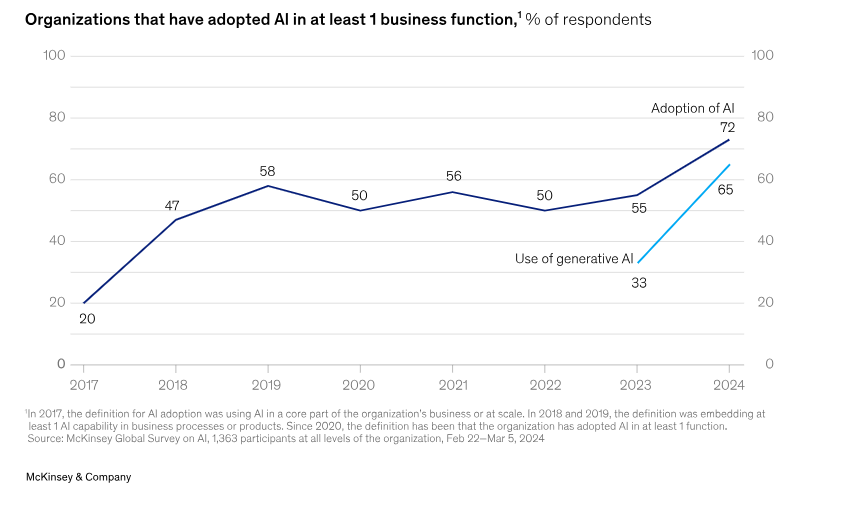
Image Source – www.mckinsey.com
That architectural choice reflects production discipline: Structured schema design, ACID compliance, scaling readiness, and cost-aware engineering.
Yet many AI products are built through rapid “vibe coding”—prioritizing speed, surface functionality, and quick deployment over database engineering, indexing discipline, and scalability planning.
These applications often ignore optimization layers that determine survivability under real-world load.
This is where CodeConductor jumps in, embedding AI application optimization directly into backend generation, integrating relational modeling, index-aware query construction, replication-ready architecture, and infrastructure observability from day one rather than retrofitting performance later.
If OpenAI’s infrastructure signals what production AI requires, the next question becomes clear: why do so many AI builders still ignore these optimization fundamentals?
In This Post
- The Illusion of Vibe Coding
- OpenAI’s PostgreSQL Decision – What It Signals About Production AI?
- Relational Discipline – Why PostgreSQL Still Powers Serious AI Systems
- SONB & Indexing – The Optimization Layer Most AI Builders Skip
- Query Planning & Execution — Where Performance Is Won
- Replication & Horizontal Scaling — Engineered for Load
- Availability & Load Comparison
- Observability — The Visibility Layer Most AI Builders Ignore
- Hybrid Architecture – Why Vector Databases Are Not Enough
- The Optimization Gap – Why Most AI Apps Never Reach Production Stability
- How CodeConductor Embeds AI Application Optimization From Day One?
- Architectural Cohesion vs Reactive Engineering
- Where CodeConductor Aligns
The Illusion of Vibe Coding
Vibe-coded AI applications prioritize speed and rapid deployment over database engineering, indexing strategy, replication planning, and infrastructure optimization.
While this approach accelerates prototyping, it often ignores the architectural foundations required for scalability, performance stability, and long-term production reliability.
Vibe coding feels productive because it reduces friction. Developers connect a model API, attach a lightweight database, deploy to a cloud platform, and ship features quickly. Early demos work. Small user groups experience minimal latency. The system appears stable.
The problem is not functionality. The problem is architecture.
Vibe-coded systems typically:
- Default to unmanaged or minimally configured databases
- Store semi-structured data without index planning
- Avoid schema normalization
- Skip replication and failover configuration
- Launch without observability or performance monitoring
These decisions reduce development time in the short term. They increase performance risk in the long term.
Why Optimization Gets Ignored?
Optimization is often deferred because:
- Early traffic volume is low
- The infrastructure cost appears minimal
- Query performance seems acceptable
- Scaling requirements feel distant
However, infrastructure debt compounds faster than feature debt.
When user growth increases:
- Query latency rises
- CPU utilization spikes
- Lock contention appears
- Database bottlenecks surface
- Cloud costs escalate unpredictably
These failures do not originate in the AI model. They originate from missing optimization layers.
The Psychological Trap
Rapid AI builders optimize for visible progress:
- UI responsiveness
- Model output quality
- Feature iteration speed
Production systems optimize for invisible stability:
- Transaction isolation
- Index efficiency
- Replication topology
- Failure recovery
- Cost control under load
The difference is architectural foresight.
What OpenAI’s Infrastructure Signals
When organizations operating at a global scale choose relational discipline, query planning maturity, and replication readiness, it signals that optimization is not optional. It is foundational.
Vibe-coded applications assume scaling can be added later. Production AI systems assume scaling must be engineered before traffic arrives.
That distinction defines survivability.
This leads to the next critical layer:
If serious AI systems prioritize infrastructure discipline, what specific architectural decisions separate them from rapidly built applications?
OpenAI’s PostgreSQL Decision – What It Signals About Production AI?
According to InfoQ, OpenAI uses PostgreSQL as a primary relational store within ChatGPT’s broader infrastructure stack, supporting critical workloads at massive scale. This signals that production AI systems rely on relational databases, structured schema design, JSONB support, query optimization, and replication readiness alongside other technologies to maintain performance and reliability at scale.
OpenAI’s decision to anchor key ChatGPT workloads on PostgreSQL signals infrastructure discipline rather than rapid experimentation, emphasizing structured schema design, transactional integrity, and predictable scaling.
PostgreSQL is a mature relational database known for transactional integrity, extensible indexing, and performance tuning capabilities.
The InfoQ report highlights that OpenAI leverages PostgreSQL features such as relational consistency and JSONB support to manage application workloads (Source). PostgreSQL provides:
- ACID-compliant transactions
- Cost-based query planning
- Advanced indexing mechanisms (including JSONB indexing)
- Replication and high-availability support
- A mature extension ecosystem
These features are associated with long-term production stability, not short-term prototyping convenience.
What This Decision Signals About Production AI
Despite the growing popularity of vector databases for embedding storage and semantic retrieval, OpenAI maintains relational infrastructure as part of its architectural foundation.
That signals several principles:
- AI systems manage structured and transactional data in addition to embeddings.
- Data integrity must remain consistent under concurrent access.
- Query performance must remain predictable as datasets grow.
- Scaling strategies require deliberate engineering rather than reactive upgrades.
Relational databases address these requirements through constraint enforcement, query optimization, and replication capabilities.
Why Vibe-Coded Applications Overlook This Layer?
Rapid AI builders often prioritize immediate functionality over infrastructure planning. Common patterns include:
- Default database configurations without performance tuning
- Minimal schema enforcement
- Delayed indexing strategy
- Single-instance deployments without redundancy
These shortcuts reduce development friction early. However, they increase fragility as traffic grows.
When concurrency increases:
- Unindexed queries slow significantly
- Schema inconsistencies surface
- Single-node bottlenecks limit throughput
- Failover gaps increase downtime risk
The absence of relational discipline compounds over time.
Architectural Contrast
| Infrastructure Principle | Production-Engineered AI | Vibe-Coded AI |
|---|---|---|
| Database Usage | Mature relational systems are integrated intentionally | Convenience-first configuration |
| Data Integrity | Enforced through constraints and transactions | Loosely structured |
| Query Planning | Analyzed and optimized | Default execution paths |
| Replication | Designed for availability | Added reactively |
| Scaling Strategy | Engineered before traffic growth | Considered after performance issues |
The difference is not model capability. It is architectural maturity.
If relational discipline forms the backbone of production AI systems, the next question becomes more granular:
Which optimization layers inside relational systems actually determine scalability and performance predictability?
Relational Discipline – Why PostgreSQL Still Powers Serious AI Systems
Relational discipline ensures data integrity, transactional consistency, and predictable system behavior in production AI systems.
PostgreSQL remains foundational because it enforces structured schema design, manages concurrent transactions safely, and maintains reliable state transitions under load.
Basically, the relational discipline is not about legacy preference. It is about structural control.
Production AI systems handle far more than model inference. They manage user identities, billing records, permissions, audit logs, configuration states, feedback data, and operational metadata alongside embeddings and generated outputs. These workloads require:
- Explicit relationships between entities
- Constraint enforcement at the database level
- Controlled concurrency handling
- Safe state transitions during updates
Without structural enforcement, system behavior becomes unpredictable as complexity increases.
What Relational Discipline Actually Means
Relational discipline begins with deliberate data modeling.
It includes:
- Schema-defined architecture
- Clearly typed columns
- Defined relationships between tables
- Structured data boundaries
- Database-level constraints
- Primary and foreign key enforcement
- Uniqueness guarantees
- Referential integrity protection
- Transaction isolation
- Atomic updates
- Consistent read/write behavior
- Protection against race conditions
These mechanisms ensure that growth in traffic or data volume does not introduce silent corruption or an inconsistent state.
Structure prevents instability before scale magnifies it.
Why OpenAI’s Stack Reflects This Discipline
According to InfoQ, OpenAI uses PostgreSQL as part of ChatGPT’s infrastructure stack.Choosing a relational database signals architectural intent: enforce structure early so system behavior remains stable under concurrency and growth.
Relational systems are designed to:
- Maintain a consistent state during simultaneous requests
- Protect data integrity through enforced relationships
- Provide deterministic outcomes during complex updates
These properties matter most when user activity scales.
Where Vibe-Coded Applications Deviate?
Vibe-coded systems often treat the database as flexible storage rather than as an enforcement layer. Common shortcuts include:
- Allowing schema drift without normalization
- Handling relational logic exclusively in application code
- Ignoring transaction isolation planning
- Deferring integrity validation
At low traffic, these shortcuts appear harmless. Under concurrency, they introduce:
- Duplicate records
- Partial state updates
- Broken entity relationships
- Increasing query complexity
The absence of relational discipline converts early development speed into long-term fragility.
Integrity & Structural Comparison
| Structural Principle | Relational-Engineered System | Vibe-Coded System |
|---|---|---|
| Data Relationships | Enforced in the database schema | Managed inconsistently in code |
| Constraints | Guaranteed at the storage layer | Optional or delayed |
| Transaction Safety | Controlled under concurrency | Vulnerable to race conditions |
| State Consistency | Deterministic | Prone to edge-case failures |
Relational discipline protects systems before scale exposes architectural weaknesses.
Structure establishes integrity. However, integrity alone does not ensure speed.
The next performance layer determines how efficiently structured and semi-structured data is retrieved, filtered, and indexed under real-world traffic:
Indexing and query optimization.
SONB & Indexing – The Optimization Layer Most AI Builders Skip
JSONB and indexing strategies determine how efficiently semi-structured and relational data are retrieved in production AI systems. Proper indexing reduces query latency, prevents full-table scans, and maintains performance predictability as datasets grow.
Relational structure protects integrity. Indexing protects speed.
Moreover, modern AI systems rarely operate on purely rigid schemas. They manage dynamic metadata, feature flags, model configurations, user preferences, and contextual attributes that evolve. PostgreSQL’s JSONB data type enables semi-structured storage while retaining queryability.
However, storing flexible data is not the same as optimizing it.
What JSONB Enables in AI Systems?
JSONB allows structured storage of evolving attributes without abandoning relational discipline. It supports:
- Nested key-value structures
- Efficient binary storage format
- Queryable fields inside JSON documents
- Compatibility with relational joins
This flexibility makes it suitable for AI workloads where metadata evolves frequently.
But flexibility without indexing creates performance risk.
Why Indexing Determines Scalability?
Official PostgreSQL indexing documentation: https://www.postgresql.org/docs/current/indexes.html
Indexes reduce the number of rows scanned during query execution. Without indexing, the database must inspect large portions of a table, increasing CPU load and latency.
Effective indexing strategies include:
- B-Tree indexes
- Optimize equality and range filters
- Common for primary keys and timestamp queries
- GIN indexes (for JSONB)
- Enable efficient search within JSON fields
- Reduce scan cost for nested attributes
- Composite indexes
- Optimize multi-condition filtering
- Improve performance for complex queries
As the dataset size increases, indexed queries maintain predictable execution patterns. Unindexed queries degrade progressively.
What Happens When Indexing Is Ignored
Applications built without deliberate indexing often experience:
- Slow response times under concurrent access
- Increased CPU and memory consumption
- Escalating infrastructure costs
- Query time variability under load
The issue does not appear immediately. It emerges as data volume expands.
Indexing is not an optimization reserved for later stages. It is a prerequisite for scalable growth.
Structural Performance Comparison
| Query Behavior | Indexed System | Unindexed System |
|---|---|---|
| Row Scanning | Targeted lookups | Sequential table scans |
| Latency Stability | Predictable | Degrades as data grows |
| Resource Usage | Controlled | Increasing CPU overhead |
| Scalability | Linear growth tolerance | Performance volatility |
Predictable performance depends on minimizing unnecessary row evaluation.
Why This Layer Is Commonly Skipped
Rapid AI builders often:
- Store JSON without index planning
- Add indexes reactively after performance drops
- Over-index without analyzing query patterns
- Ignore query cost inspection tools
These practices create instability rather than sustainable optimization.
Semi-structured data is powerful. Structured indexing makes it scalable.
Integrity ensures correctness. Indexing ensures efficiency.
Query Planning & Execution — Where Performance Is Won
Query planning determines how a database executes a request by selecting the most efficient execution path. Proper query analysis reduces latency, lowers resource usage, and maintains performance stability under concurrent load.”
Indexes reduce lookup cost. Query planning determines how those indexes are used.
When a query runs, the database:
- Estimates matching row counts
- Selects join strategies
- Determines index usage
- Calculates execution cost
If queries are poorly structured or statistics are inaccurate, inefficient execution paths are chosen.
Tools That Expose Query Behavior
PostgreSQL provides built-in diagnostics:
- EXPLAIN
→ Displays the planned execution strategy. - EXPLAIN ANALYZE
→ Executes the query and shows actual runtime behavior, comparing estimates with real execution.
These tools reveal:
- Sequential scans
- Expensive join paths
- Cardinality misestimates
- Index underutilization
Without inspecting execution plans, inefficiencies remain invisible until traffic increases.
Common Performance Pitfalls
- Filtering on non-indexed columns
- Inefficient JOIN conditions
- Over-fetching unnecessary columns
- Repeated identical queries
Under concurrency, small inefficiencies multiply.
Execution Impact Comparison
| Execution Behavior | Optimized Query | Unoptimized Query |
|---|---|---|
| Index Usage | Targeted | Ignored |
| Join Strategy | Cost-based | Inefficient |
| Resource Use | Controlled | Escalating |
| Latency Stability | Predictable | Variable |
Query efficiency determines cost per request and response stability.
As traffic grows, execution cost compounds. The next layer determines how the workload is distributed across the infrastructure to prevent bottlenecks:
Replication and horizontal scaling.
Replication & Horizontal Scaling — Engineered for Load
Replication and horizontal scaling distribute database workload across multiple nodes to improve availability, reduce latency, and prevent bottlenecks. These strategies ensure production AI systems remain stable under increasing traffic and concurrent demand.
Efficient queries reduce cost per request. Scaling architecture determines how the system behaves when the request volume multiplies.
As AI applications grow, user traffic, background processing, API integrations, and data updates occur simultaneously. A single database instance becomes a bottleneck when:
- Read traffic overwhelms CPU resources
- Write operations increase lock contention
- Geographic users experience high latency
- Failures create downtime without redundancy
Scaling must be engineered before these conditions appear.
Replication: Distributing Read Workloads
Replication creates copies of the primary database to handle read-heavy traffic.
PostgreSQL supports streaming replication and read replicas (official documentation:
https://www.postgresql.org/docs/current/warm-standby.html).
Replication enables:
- Read query distribution
- Reduced primary node pressure
- High availability during hardware failure
- Faster geographic response times
Without replication, all traffic converges on a single instance.
Horizontal Scaling: Expanding Capacity Across Nodes
Horizontal scaling adds additional instances instead of increasing hardware on a single machine.
This approach supports:
- Load-balanced traffic distribution
- Fault isolation
- Regional redundancy
- Controlled capacity expansion
Unlike vertical scaling, horizontal strategies prevent single points of failure.
What Happens Without a Scaling Strategy
Applications launched without replication or scaling planning often encounter:
- Latency spikes under concurrent usage
- Increased timeout errors
- Maintenance-related downtime
- Escalating infrastructure costs due to emergency scaling
Traffic growth magnifies architectural limitations.
Availability & Load Comparison
| Infrastructure Design | Engineered for Load | Single-Instance Setup |
|---|---|---|
| Read Handling | Distributed across replicas | Centralized |
| Failure Recovery | Automated failover | Manual intervention |
| Traffic Distribution | Load-balanced | Bottlenecked |
| Growth Management | Incremental scaling | Reactive hardware upgrades |
Workload distribution preserves stability during demand surges.
Why This Layer Is Often Deferred
Rapid AI deployments are frequently:
- Rely on default single-instance configurations
- Add replicas only after performance incidents
- Treat scaling as a cloud setting rather than an architectural decision
Scaling is not a toggle. It is a design principle.
As traffic expands, the next challenge is not just distributing workload — it is understanding system behavior in real time.
That requires:
Observability and performance monitoring.
Observability — The Visibility Layer Most AI Builders Ignore
Observability enables AI systems to monitor query latency, resource usage, error rates, and system behavior in real time. Without monitoring, performance bottlenecks remain undetected until failures impact users.
Scaling distributes workload. Observability explains system behavior under that workload.
Production AI systems require visibility into:
- Query latency
- CPU and memory utilization
- Lock contention
- Error rates
- Throughput trends
Without these signals, teams react to incidents instead of preventing them.
What Observability Provides
Effective monitoring allows teams to:
- Detect performance degradation early
- Identify inefficient queries
- Trace request bottlenecks
- Measure scaling effectiveness
- Prevent cascading failures
Visibility converts infrastructure from guesswork into measurable control.
What Happens Without It
Systems launched without observability often experience:
- Undiagnosed latency spikes
- Delayed failure detection
- Increased downtime during incidents
- Reactive troubleshooting under pressure
Once visibility is established, one final architectural question remains:
How do relational systems coexist with vector databases in modern AI stacks?
Hybrid Architecture – Why Vector Databases Are Not Enough
Hybrid architecture combines relational databases with vector databases to support both structured transactions and semantic search. Relational systems manage consistency and business logic, while vector systems power embedding retrieval. Production AI requires both layers to operate efficiently at scale.
Modern AI systems handle two fundamentally different workloads:
- Structured operational data (users, billing, permissions, logs)
- High-dimensional embeddings for semantic retrieval
These workloads have different performance characteristics and storage requirements.
A single database model cannot efficiently optimize both.
What Happens Without a Hybrid Strategy
Applications that rely exclusively on:
- Relational systems may struggle with high-speed embedding retrieval.
- Vector-only systems may lack transactional integrity and structured enforcement.
Balanced architecture prevents performance trade-offs from becoming systemic weaknesses.
Hybrid infrastructure addresses storage specialization. One final strategic gap remains:
Even when architecture is technically sound, many AI builders fail to integrate these optimization layers holistically from the start.
The next section will address that gap.
The Optimization Gap – Why Most AI Apps Never Reach Production Stability
Most AI applications fail to reach production stability because optimization is treated as a post-launch task instead of a foundational design principle. Without structured data modeling, indexing strategy, query planning, replication, scaling, and observability integrated from the start, performance debt compounds as usage grows.
Every layer discussed — relational modeling, JSONB indexing, query planning, replication, horizontal scaling, observability, and hybrid architecture — forms part of a cohesive system.
The failure rarely happens at the model layer.
It happens when these optimization layers are:
- Added reactively
- Implemented partially
- Misaligned across the stack
- Deferred until traffic increases
Optimization debt compounds quietly.
How Optimization Debt Accumulates
When systems are launched without an integrated infrastructure discipline:
- The schema evolves inconsistently
- Indexes are added reactively
- Queries are optimized after complaints
- Replication is introduced after outages
- Monitoring begins after failures
Each reactive decision increases architectural complexity.
The result is:
- Rising latency variance
- Escalating infrastructure costs
- Operational fragility
- Increasing maintenance overhead
Growth amplifies weaknesses.
OpenAI’s infrastructure decisions signal that scalable AI requires disciplined architecture — relational enforcement, indexing strategy, execution analysis, replication, workload distribution, and visibility.
Optimization is not a feature. It is a structural property of the system.
How CodeConductor Embeds AI Application Optimization From Day One?
CodeConductor embeds AI application optimization into backend architecture by integrating structured data modeling, index-aware query generation, replication-ready deployment patterns, scaling strategies, and observability from the outset.
Optimization is built into system design rather than added after performance issues emerge.
The architectural layers discussed throughout this article—relational discipline, JSONB indexing, query planning, replication, horizontal scaling, observability, and hybrid database strategy- only deliver value when implemented cohesively.
Many AI systems fail not because these components are unavailable, but because they are assembled reactively.
Production stability requires integration, not patchwork.
What Integrated Optimization Looks Like?
Embedding optimization from the start means:
- Designing schema structures intentionally
- Planning indexing based on query patterns
- Evaluating execution cost before scale
- Configuring replication as part of deployment
- Monitoring performance from launch
- Aligning relational and vector workloads appropriately
These elements must function as a coordinated system.
When optimization is deferred, each adjustment introduces new complexity. When it is foundational, scaling remains controlled.
Architectural Cohesion vs Reactive Engineering
| System Approach | Integrated Optimization | Reactive Adjustments |
|---|---|---|
| Schema Planning | Designed intentionally | Refactored repeatedly |
| Indexing | Query-aware | Added after the slowdown |
| Execution Analysis | Proactive | Incident-driven |
| Scaling | Structured deployment | Emergency expansion |
| Monitoring | Enabled from launch | Activated after the outage |
Integrated systems maintain predictable growth trajectories.
Where CodeConductor Aligns
CodeConductor is built around AI application optimization as a structural principle.
Instead of generating rapid prototypes that require backend refactoring later, the platform integrates:
- Relational modeling discipline
- Index-aware backend generation
- Replication-conscious deployment patterns
- Scalable infrastructure design
- Observability-ready architecture
Optimization becomes a property of the system itself — not a corrective measure applied after traffic exposes weaknesses.
If you’re building AI products meant to survive beyond the prototype phase, infrastructure discipline cannot be optional.
Try CodeConductor for free for a limited time and experience what production-ready AI architecture looks like when optimization is built in from day one.

Founder CodeConductor