
Are modern engineering teams struggling to manage the growing complexity of cloud infrastructure, deployment pipelines, and developer workflows?
As organizations adopt microservices architectures, container orchestration, and multi-cloud strategies, the software delivery lifecycle has become significantly more complex.
Engineering teams must now coordinate infrastructure provisioning, CI/CD automation, monitoring, security, and developer experience across dozens of tools and platforms.
This growing complexity has driven the rise of platform engineering tools and internal developer platforms (IDPs), which help organizations
- Standardize infrastructure,
- Automate development workflows, and
- Provide developers with self-service environments.
Industry research confirms that platform engineering is rapidly becoming a core capability for modern software organizations.
According to the Puppet’s 2023 Platform Engineering Report, 93% of organizations are either implementing platform engineering or evaluating it as part of their software delivery strategy. Source
This shift reflects a broader movement toward internal developer platforms that simplify infrastructure management and improve developer productivity.
To build these platforms, engineering teams rely on a combination of technologies such as Kubernetes, Terraform, Backstage, Argo CD, Prometheus, and Vault.
These technologies form the foundation of modern platform engineering stacks by automating infrastructure provisioning, managing containerized workloads, enabling GitOps deployment, and providing observability across distributed systems.
However, managing such a large ecosystem of tools can quickly become complex. Platforms like CodeConductor aim to simplify this ecosystem by supporting and integrating many of these platform engineering tools within a unified development and infrastructure workflow.
By automating infrastructure setup, application deployment, and environment configuration, these platforms help organizations reduce operational complexity while enabling developers to focus on building and delivering software faster.
In this guide, we’ll explore
- The most important platform engineering tools,
- Explain how they fit into a modern platform architecture, and
- Examine how organizations can build scalable internal developer platforms.
So, without any further ado, let’s start exploring!!!
In This Post
- What is Platform Engineering?
- Platform Engineering Tools and Architecture
- How Platform Engineering Tools Work Together in Practice
- Step 1: Developer Initiates a Service
- Step 2: Platform Orchestration Coordinates the Environment
- Step 3: Infrastructure Is Provisioned Automatically
- Step 4: Applications Are Deployed Through GitOps
- Step 5: Applications Run on the Runtime Platform
- Step 6: Observability Tools Monitor System Health
- Step 7: Security Policies Protect the Platform
- How do Organizations Build an IDP Without Adding More Complexity?
- The Future of Platform Engineering: AI-Driven Platforms
- Conclusion
- FAQs About Platform Engineering?
What is Platform Engineering?
Platform engineering is the practice of building internal developer platforms that give software teams self-service access to infrastructure, deployment workflows, and operational controls.
A platform team creates these shared capabilities so developers can build, ship, and manage applications without manually handling every infrastructure task.
Why Platform Engineering Emerged
Platform engineering emerged because modern software delivery became harder to manage at scale. Microservices, Kubernetes, cloud infrastructure, CI/CD pipelines, security controls, and observability systems introduced too many moving parts for individual application teams to manage efficiently.
Platform engineering solves this problem by standardizing common workflows and reducing developer cognitive load.
Platform Engineering vs DevOps – Deep Comparison
The main difference between platform engineering and DevOps is that DevOps defines collaborative practices, while platform engineering builds internal platforms that deliver those practices through self-service workflows.
| Feature | DevOps | Platform Engineering |
|---|---|---|
| Primary Objective | Improve collaboration between development and operations teams | Build internal platforms that simplify software delivery |
| Operating Model | Teams implement CI/CD pipelines and infrastructure automation individually | Platform teams build shared services that developers access through self-service workflows |
| Developer Experience | Developers interact with multiple infrastructure and deployment tools | Developers use a unified internal developer platform |
| Infrastructure Management | Application teams often configure infrastructure directly | Infrastructure is abstracted through platform APIs, templates, and automation |
| Tool Usage | Teams assemble toolchains such as CI/CD, monitoring, and deployment tools | Platform teams integrate tools into a standardized platform stack |
| Organizational Structure | DevOps practices spread across engineering teams | Dedicated platform teams manage the internal platform |
| Outcome | Faster software delivery through automation and collaboration | Scalable developer platforms that reduce operational complexity |
Platform engineering builds on DevOps principles by standardizing infrastructure, deployment pipelines, and operational workflows inside an internal developer platform (IDP).
Instead of every team managing its own toolchain, developers use a shared platform that automates infrastructure provisioning, deployment processes, and operational controls.
This evolution naturally leads to the next topic: the platform engineering tools that power internal developer platforms and how they fit into the platform architecture.
What is an Internal Developer Platform (IDP)?
An internal developer platform, or IDP, is the practical output of platform engineering.
IDP combines
- Infrastructure automation,
- Deployment workflows,
- Developer portals,
- Security guardrails, and
- Observability into a unified system that developers can use through self-service workflows.
In many organizations, the IDP has become the operational layer that connects tools such as Kubernetes, Terraform, Backstage, Argo CD, Prometheus, and Vault into one standardized developer experience.
This foundation directly leads to the platform engineering tools and architecture that make an internal developer platform work.
Platform Engineering Tools and Architecture
Some of the most widely used platform engineering tools include:
- Kubernetes – container orchestration
- Terraform – infrastructure provisioning
- Argo CD – GitOps deployment
- Prometheus – monitoring
- Grafana – observability dashboards
- Vault – secrets management
- Backstage – developer portal
- Humanitec – platform orchestration
A modern platform engineering architecture consists of several layers of specialized tools that automate
- Infrastructure provisioning,
- Application deployment,
- Monitoring and security.
Each layer performs a specific role, but together they create a unified platform that enables developers to build, deploy, and operate applications through standardized workflows.
Most platform engineering stacks follow a layered architecture that starts with a developer interface and extends through orchestration, infrastructure automation, runtime environments, observability systems, and security controls. By organizing tools into these layers, platform teams can integrate best-of-breed technologies while maintaining a consistent developer experience.
Let’s explore these layers in detail:
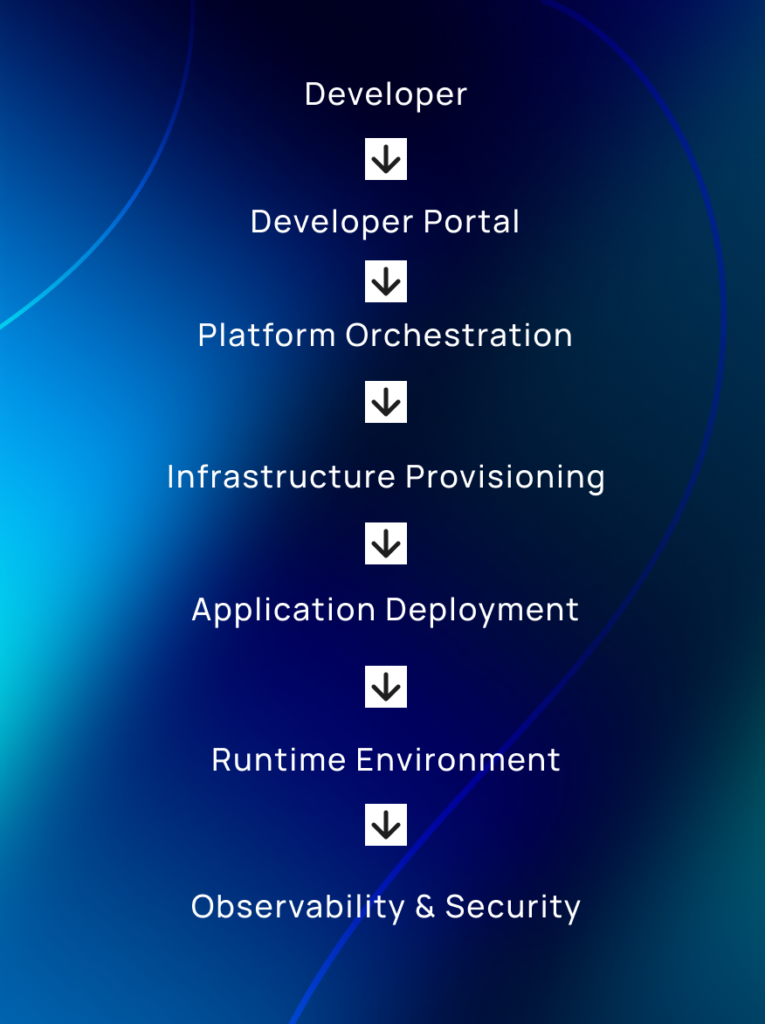
Developer Portal Layer
The developer portal layer acts as the main interface between developers and the internal developer platform. Developer portals centralize documentation, service catalogs, infrastructure templates, and deployment workflows, so developers can access platform capabilities from a single interface.
Common developer portal tools include:
- Backstage – an open-source developer portal created by Spotify. Backstage provides a centralized service catalog, plugin integrations, and developer workflows that help teams discover services and manage deployments.
- Port – an internal developer portal that helps platform teams track service ownership, infrastructure resources, and operational insights across engineering environments.
Developer portals simplify platform interactions by providing a single entry point for developer workflows and platform services.
Platform Orchestration Layer
The platform orchestration layer coordinates infrastructure resources, application environments, and deployment configurations across the platform. It ensures that infrastructure dependencies and environment configurations are automatically managed.
Key tool:
- Humanitec – a platform orchestration system that provides an abstraction layer between applications and infrastructure. Humanitec enables developers to deploy applications without needing to understand the underlying infrastructure configuration.
Platform orchestration tools help enforce infrastructure policies while simplifying developer workflows.
Infrastructure Provisioning Layer
The infrastructure provisioning layer automates the creation and configuration of cloud infrastructure resources such as compute instances, networking systems, and storage environments.
These capabilities are typically implemented using Infrastructure as Code (IaC) tools.
Common tools include:
- Terraform – a widely used infrastructure-as-code tool that allows organizations to define infrastructure using declarative configuration files.
- Pulumi – an infrastructure automation platform that enables developers to define infrastructure using programming languages such as Python, TypeScript, and Go.
- Crossplane– a Kubernetes-native control plane that allows cloud infrastructure resources to be managed using Kubernetes APIs.
These tools help platform teams create reproducible and scalable infrastructure environments.
Deployment and GitOps Layer
The deployment and GitOps layer automates application delivery and ensures that system configurations remain synchronized with version-controlled repositories.
Common deployment tools include:
- Argo CD – a GitOps continuous delivery tool for Kubernetes that automatically synchronizes application configurations from Git repositories to clusters.
- Flux – a GitOps automation tool that continuously applies configuration changes from Git repositories to Kubernetes environments.
- Jenkins – a widely used CI/CD automation server that allows teams to build, test, and deploy applications through customizable pipelines.
These tools enable automated and consistent application deployment workflows.
Runtime Layer
The runtime layer provides the infrastructure environment where applications run and scale.
Core runtime tools include:
- Kubernetes – the industry standard for container orchestration, managing container deployment, scaling, and networking.
- Docker – a containerization platform that packages applications and dependencies into portable containers.
- Helm – a Kubernetes package manager that simplifies the deployment of complex containerized applications using reusable templates.
Together, these tools provide a scalable runtime environment for modern cloud-native applications.
Observability Layer
The observability layer provides monitoring, logging, and distributed tracing capabilities that help teams understand application behavior and system performance.
Common observability tools include:
- Prometheus – an open-source monitoring system that collects and stores metrics from applications and infrastructure.
- Grafana – a visualization platform that creates dashboards for monitoring system performance and operational metrics.
- OpenTelemetry – an observability framework for collecting metrics, logs, and traces across distributed systems.
These tools provide the visibility required to maintain reliability and diagnose system issues.
Security Layer
The security layer protects infrastructure resources, manages credentials, and enforces security policies across the platform.
Common security tools include:
- HashiCorp Vault – a secrets management system used to securely store credentials, API keys, and encryption keys.
- Open Policy Agent (OPA) – a policy engine that allows organizations to enforce infrastructure and application policies.
- Istio – a service mesh that manages secure communication, traffic control, and policy enforcement between microservices.
These tools ensure that platform infrastructure remains secure, compliant, and resilient.
This layered architecture demonstrates how platform engineering tools combine to create a scalable internal developer platform.
As platform engineering ecosystems grow, platforms such as CodeConductor aim to support many of these platform engineering tools within a unified platform environment, simplifying how infrastructure, deployment, and observability workflows are managed.
In the next section, we will explore how these tools work together in real-world workflows and how organizations can build an internal developer platform using them effectively.
How Platform Engineering Tools Work Together in Practice
In a mature platform engineering environment, developers interact with a unified platform that automates infrastructure provisioning, application deployment, monitoring, and security controls behind the scenes.
Instead of manually configuring infrastructure or managing multiple deployment tools, developers use self-service workflows provided by the internal developer platform.
Step 1: Developer Initiates a Service
A developer begins by creating or updating a service through the developer portal, such as Backstage or Port. The portal provides templates and service catalogs that allow developers to create new services with standardized configurations.
For example, a developer may choose a predefined service template that includes container configurations, deployment policies, and observability integrations.
Step 2: Platform Orchestration Coordinates the Environment
Once the service is created, the platform orchestration layer coordinates environment configuration and infrastructure dependencies.
Tools like Humanitec ensure that the application environment follows platform standards, while automatically resolving dependencies such as databases, networking, and storage resources.
Step 3: Infrastructure Is Provisioned Automatically
The platform then provisions infrastructure using Infrastructure as Code tools such as Terraform or Pulumi.
These tools create the required infrastructure resources, including:
- Cloud compute instances
- Networking configurations
- Container clusters
- Storage systems
Infrastructure provisioning happens automatically through platform workflows.
Step 4: Applications Are Deployed Through GitOps
Once infrastructure is ready, the deployment pipeline triggers application deployment.
GitOps tools such as Argo CD or Flux synchronize application configurations from Git repositories with Kubernetes clusters. This ensures that the deployed system always matches the configuration defined in version control.
Step 5: Applications Run on the Runtime Platform
The deployed applications run within the container runtime environment.
Typically, this environment includes:
- Kubernetes for container orchestration
- Docker for containerized workloads
- Helm for managing Kubernetes deployments
These tools ensure that applications scale automatically and remain highly available.
Step 6: Observability Tools Monitor System Health
After deployment, observability platforms monitor system performance and operational health.
Tools such as Prometheus, Grafana, and OpenTelemetry collect telemetry data, including:
- System metrics
- Application logs
- Distributed traces
This visibility helps engineering teams identify performance issues and maintain system reliability.
Step 7: Security Policies Protect the Platform
Throughout the workflow, security systems enforce access control and protect sensitive data.
Tools such as Vault, Open Policy Agent (OPA), and Istio manage:
- Secrets and credentials
- Infrastructure policies
- Secure service communication
These tools ensure applications run in secure and compliant environments.
How do Organizations Build an IDP Without Adding More Complexity?
Organizations build an IDP in stages. A strong internal developer platform starts with:
- A clear platform strategy,
- A dedicated platform team, and
- Standardized developer workflows.
The goal is not to add more tools. The goal is to turn infrastructure, deployment, security, and observability into a consistent self-service platform that developers can use with less friction.
Define the Platform Team
The first step is to define platform ownership. A platform engineering team should own the internal developer platform as a product for developers. This team sets
- Standards,
- Maintains shared services, and
- Improves the platform based on engineering needs.
Clear ownership prevents fragmented tooling and inconsistent workflows across teams.
Design Developer Workflows
The next step is to define how developers should interact with the platform. These workflows should cover common actions such as
- Creating a service,
- Requesting an environment,
- Deploying an application, and
- Accessing operational data.
Standardized workflows make software delivery faster and more predictable. They also reduce manual handoffs between development, operations, and security teams.
Build the Developer Experience
Once workflows are defined, the platform should present them through a simple developer experience.
This usually includes
- A developer portal,
- Service templates,
- Documentation and self-service actions.
The goal is to give developers a clear path for common tasks, instead of managing multiple tools and approval chains.
Automate Platform Operations
After the developer experience is in place, the platform should automate the underlying operational tasks.
This includes:
- Provisioning infrastructure,
- Applying deployment standards,
- Enforcing policies, and
- Connecting operational services behind the scenes.
Automation is what turns a collection of tools into a usable internal developer platform.
Embed Observability and Security by Default
Observability and security should be built into the platform from the start. Developers should not have to add monitoring, secrets handling, or policy checks manually for every service.
The platform should provide these capabilities as default platform features. This approach improves reliability, strengthens governance, and keeps delivery workflows consistent.
Platform Engineering Best Practices
Successful internal developer platforms follow a few consistent principles. They reduce developer cognitive load. They standardize repeatable workflows. They provide self-service access with clear guardrails. They evolve based on developer feedback. Most importantly, they treat the platform as a product that must improve over time.
This implementation view shifts the discussion from platform architecture to platform adoption. The next section can now focus on where the market is heading and how AI-powered platforms are changing platform engineering.
The Future of Platform Engineering: AI-Driven Platforms
The future of platform engineering focuses on reducing tool fragmentation and improving platform scalability.
As organizations adopt dozens of infrastructure, deployment, observability, and security technologies, platform teams must manage increasingly complex toolchains.
The next evolution of platform engineering centers on platforms that simplify this ecosystem and provide clearer operational control.
Platform Abstraction and Ecosystem Integration
One major trend in platform engineering is the move toward stronger platform abstraction. Instead of exposing developers directly to every infrastructure or deployment tool, modern platforms provide higher-level interfaces that standardize how applications interact with infrastructure and services.
This approach allows platform teams to integrate tools such as Kubernetes, Terraform, Argo CD, Prometheus, and Vault behind a consistent platform interface. Developers interact with the platform, while the platform manages the underlying tooling ecosystem.
Reducing Tool Sprawl in Platform Engineering
As the platform engineering ecosystem expands, organizations often accumulate large collections of specialized tools. Each tool solves a specific problem—deployment automation, infrastructure provisioning, observability, or security—but integrating and maintaining them can become challenging.
Future platform strategies will focus on reducing tool sprawl by organizing these technologies under cohesive platform layers. Instead of managing disconnected systems, platform teams will increasingly rely on unified platforms that coordinate infrastructure, deployment, and operational services.
The Role of CodeConductor
Platforms such as CodeConductor represent this shift toward integrated platform engineering ecosystems. Rather than functioning as a single tool, CodeConductor operates as a platform that can support and work alongside many existing platform engineering tools used across infrastructure provisioning, deployment automation, runtime management, observability, and security.
By enabling platform teams to connect multiple technologies within a unified platform environment, solutions like CodeConductor help organizations manage complex platform stacks more efficiently while maintaining flexibility in their tooling choices.
Conclusion
Platform engineering works best when teams can focus on building software instead of managing complex toolchains.
The challenge today is not just adopting the right platform engineering tools, but making them work together in a way that supports developer productivity and scalable platform operations.
CodeConductor helps organizations achieve exactly that. It supports modern platform engineering ecosystems while simplifying how teams manage environments, deployments, and infrastructure workflows.
If you’re evaluating platform engineering solutions or looking to streamline your current platform stack, start a conversation with the CodeConductor team to see how it can fit into your platform strategy.
Get started with CodeConductor today
FAQs About Platform Engineering?
What role does CodeConductor play in platform engineering?
CodeConductor functions as a platform that supports and orchestrates modern platform engineering tools. The platform connects infrastructure provisioning, deployment workflows, runtime environments, observability, and security systems into a unified development workflow.
Can CodeConductor work with existing platform engineering tools?
Yes. CodeConductor supports integration with widely used platform engineering tools such as Kubernetes, Terraform, Argo CD, Prometheus, and Vault. The platform coordinates these tools to simplify infrastructure provisioning, deployment pipelines, and platform operations.
Does CodeConductor replace platform engineering tools?
No. CodeConductor does not replace platform engineering tools. The platform supports and orchestrates existing technologies used across infrastructure provisioning, deployment automation, runtime environments, observability, and security workflows.
How does CodeConductor help platform teams?
CodeConductor helps platform teams simplify platform operations. The platform enables teams to manage infrastructure workflows, application deployments, and platform environments through a centralized development interface while supporting existing platform engineering tools.
Can CodeConductor support internal developer platforms (IDPs)?
Yes. CodeConductor can support internal developer platform architectures by enabling teams to integrate infrastructure provisioning, deployment automation, runtime orchestration, observability, and security workflows within a unified platform environment.

Founder CodeConductor