Best Caffeine AI Alternative with Enterprise Security & Deployment Control | CodeConductor
AI App Development
Best Caffeine AI Alternative with Enterprise Security & Deployment Control
Looking for a Caffeine AI alternative? While Caffeine AI focuses on conversational app creation, CodeConductor.ai provides full control over deployment, security, integrations, and scalability, making it a stronger choice for building and running production-ready AI applications.
Paul Dhaliwal
Founder & Chief Executive Officer · Updated Jun 10, 2026·9 min read
What You'll Learn
4 key concepts covered
1What Caffeine AI offers for rapid, conversational app creation and updates.
2Where Caffeine AI shines for prototypes, non-technical builders, and managed hosting.
3Why complex workflows, persistence, integrations, and governance expose key limitations.
4How CodeConductor addresses enterprise security, deployment control, and scalable production needs.
Are you building AI-powered apps with Caffeine AI but starting to feel the limitations as your workflows grow more complex?
Many teams turn to Caffeine AI because it promises to generate apps quickly. You describe what you want, and the platform helps you quickly spin up functional tools. It’s streamlined, hosted, and designed to remove technical friction from early-stage builds.
That works well, at first.
But as your automation expands beyond simple flows, new challenges emerge. You may need apps that remember users across sessions. Workflows that branch intelligently. Integrations that connect deeply with APIs, databases, and external systems. Deployment flexibility that matches enterprise requirements. And collaboration controls that go beyond basic sharing.
That’s when many teams begin searching for a Caffeine AI alternative.
If you’re moving from quick prototypes to production-grade AI systems, the platform you choose matters. In this guide, we’ll break down what Caffeine AI offers, where it shines, where it can fall short, and why CodeConductor is emerging as the stronger long-term solution for scalable AI application development.
What Is Caffeine AI & What Does It Offer?
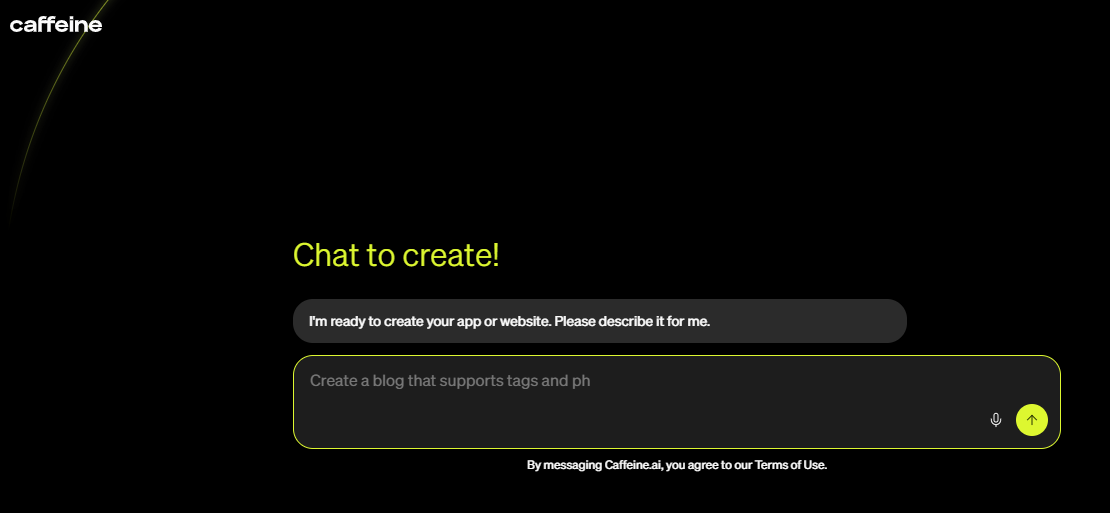
Caffeine AI is an AI-powered platform designed to let users build and maintain applications simply by chatting with AI. Instead of writing code manually, users describe features, updates, or functionality in conversation, and the platform automatically generates and updates the app.
Caffeine positions this model as “self-writing apps”, software that evolves through natural language interaction rather than traditional development workflows.
With Caffeine, you can:
Create apps through conversation Each chat session represents an app. You describe features or changes, and the platform generates or updates the live application.
Build full backend systems automatically The platform generates backend logic using a specialized framework for AI-driven software development.
Update production apps without manual deployment Changes are made in draft versions and pushed live automatically, without requiring a technical release process.
Run apps on a secure, server less network architecture Applications are deployed on a distributed infrastructure designed for resilience, availability, and automated scaling.
Reduce development complexity for non-technical users The platform is built to enable individuals or businesses to create operational apps without traditional programming skills.
Support the continuous evolution of applications Apps are designed to be updated iteratively through chat, allowing ongoing modification without rebuilding systems from scratch.
Caffeine is built around a long-term vision in which software creation becomes conversational and widely accessible, enabling businesses, teams, and individuals to generate custom apps for operational needs, workflows, or digital services.
However, as application requirements expand, particularly for complex logic, deep integrations, enterprise governance, or flexible deployment environments, teams often begin exploring platforms that offer greater control, extensibility, and production-scale architecture.
That’s when many builders start searching for a Caffeine AI alternative.
Looking for the Best Caffeine AI Alternative in 2026?
Caffeine AI introduces a compelling idea, apps that evolve through conversation and update themselves automatically. For rapid creation and managed infrastructure, that model can feel incredibly efficient.
But as applications mature, many teams begin to notice a shift in requirements.
What starts as conversational app creation quickly becomes production software management. Production software requires more than just generation speed.
Teams begin searching for a Caffeine AI alternative when they need:
Persistent application logic that extends beyond chat-based updates Real systems require structured workflows, state management, and long-term operational control.
Enterprise-grade security and access governance Production environments need role-based permissions, encryption, identity management, and compliance frameworks.
Flexible deployment environments Organizations often require control over where and how applications run, across cloud providers, on-premises infrastructure, or hybrid environments.
Deep integrations with existing systems Modern applications must connect seamlessly with databases, analytics platforms, third-party services, and internal tools.
Scalable infrastructure with operational visibility Monitoring, analytics, version control, and controlled release processes become essential as usage grows.
Full customization and extensibility Teams need the ability to modify architecture, frameworks, and application behavior, not just describe features conversationally.
This is where CodeConductor begins to stand apart.
Instead of focusing solely on conversational app generation, CodeConductor is designed to build, secure, deploy, and scale real production systems.
Rather than limiting applications to managed runtime environments, it supports:
Get insights in your inbox!!
Weekly tips on building smarter apps. Join 8,200+ founders and builders.
No spam. Unsubscribe anytime. We respect your privacy.
Multi-cloud, on-prem, and hybrid deployment
Enterprise security and compliance controls
Full code access and framework flexibility
Extensive third-party integrations
Structured development and version control
Real-time monitoring and performance optimization
And critically, security is built into the platform architecture itself.
Instead of locking teams into short-lived app sessions or opaque hosting models, CodeConductor supports:
Identity provider integration for seamless external authentication
Two-Factor Authentication (2FA) and Multi-Factor Authentication (MFA)
Role-Based Access Control (RBAC)
Enterprise encryption standards (data at rest and in transit)
Secure authentication powered by Keycloak
Compliance-ready infrastructure aligned with major regulatory standards
The result is a platform designed not just to create apps, but to operate them reliably at scale.
For teams moving beyond experimentation into real operational software, this difference becomes decisive.
CodeConductor vs Caffeine AI — Deep Feature Comparison
Below is a comprehensive side-by-side comparison to help you understand how the two platforms differ in architecture, security, scalability, and production readiness.
Core CapabilityCaffeine AICodeConductorPlatform ApproachConversational self-writing apps generated through chatFull-stack AI platform for building, customizing, deploying, and operating production applicationsDevelopment ControlAI generates and manages the application structureFull code access with customizable architecture and frameworksCustomization DepthFeature updates through conversationDeep system-level customization and extensibilityDeployment FlexibilityPlatform-managed hosting environmentMulti-cloud, on-prem, and hybrid deployment optionsInfrastructure OwnershipManaged runtimeFull infrastructure control without vendor lock-inScalability ModelNetwork-managed scalingAuto-scaling with configurable performance and resourcesSecurity ArchitecturePlatform-level safety and network protectionEnterprise-grade security with encryption, audits, and compliance standardsAccess & AuthenticationPlatform-managed user accessKeycloak authentication, RBAC, SSO, Identity provider integration, 2FA / MFACompliance ReadinessSecurity-focused architectureGDPR, HIPAA, SOC 2, PCI and audit-ready infrastructureOperational MonitoringManaged platform operationReal-time monitoring, analytics, and performance managementIntegration EcosystemPlatform-supported integrationsExtensive third-party, enterprise, and database integrationsDevelopment Lifecycle CoverageApp creation and updates through AI chatEnd-to-end lifecycle: build → customize → deploy → scale → monitor → secure
Which One Should You Use: Caffeine AI or CodeConductor?
The right platform depends on what you’re building, and how far you expect it to grow.
Some teams need speed and simplicity. Others need control, scalability, and long-term operational reliability. Understanding your stage and requirements makes the decision much clearer.
Use Caffeine AI if you want to build quickly through conversation
You want to create apps simply by chatting with AI
You’re experimenting, prototyping, or validating ideas fast
You prefer a fully managed infrastructure with minimal setup
Your applications don’t require deep customization or system control
You’re comfortable running apps within a platform-managed environment
Goal: Launch functional apps quickly with minimal technical complexity.
Use CodeConductor if you’re building AI applications that must operate at scale
You need full control over application architecture and infrastructure
Your systems must integrate with enterprise tools, databases, and services
Security, compliance, and access governance are critical requirements
You want flexible deployment across cloud, on-prem, or hybrid environments
Your apps must scale, evolve, and support long-term operational workflows
Instead of limiting development to conversational updates, CodeConductor supports structured production environments with enterprise-grade controls, including:
Secure authentication powered by Keycloak
Identity provider integration for external login and signup
Two-Factor and Multi-Factor Authentication (2FA / MFA)
Role-Based Access Control (RBAC) for granular permissions
Full infrastructure and deployment flexibility
Goal: Build intelligent applications that are secure, scalable, customizable, and production-ready from day one.
What do you like best about CodeConductor? The code of conduct is used by my company for a series of behaviors to be observed towards colleagues and customers, it is very useful to understand all the regulations in your country
What do you dislike about CodeConductor? It helped me on how to behave with a customer, what to say and not say to colleagues so as not to offend their sensitivity and avoid problems of incorrect conduct
What problems is CodeConductor solving and how is that benefiting you? Helps with how certain corporate affairs should be resolved, such as managing corporate agreements with very important clients, avoiding making legal mistakes and getting into disputes with the country they belong to.
In a Nutshell: Which is the Best Alternative to Caffeine AI in 2026?
If you want to create apps simply by chatting with AI and prefer a fully managed environment, Caffeine AI offers a fast and accessible way to get started.
But if you need applications that:
Run securely in real production environments
Integrate deeply with enterprise systems and data sources
Support flexible deployment across cloud, on-prem, or hybrid infrastructure
Scale reliably as usage grows
Provide full control over architecture, access, and compliance
Combine AI automation with real development flexibility
Then CodeConductor is not just an alternative, it’s the platform built for long-term operational software.
Caffeine AI helps you quickly generate apps.
CodeConductor helps you build, run, secure, and scale intelligent systems.
For teams moving beyond experimentation into real-world deployment, that difference matters.
Ready to build applications that last?
Start with CodeConductor to create AI-powered systems that deliver security, scalability, and complete control.
Best Caffeine AI Alternative
See how CodeConductor helps enterprises ship faster while staying compliant.
CodeConductor is a strong alternative to Caffeine AI for teams that require production-ready applications, enterprise-grade security, flexible deployment, and full customization. While Caffeine AI focuses on conversational app creation, CodeConductor supports the entire application lifecycle, from development through scaling and monitoring.
What is Caffeine AI?
Caffeine AI is an AI-powered platform that lets users create and update applications simply by chatting with AI. Instead of traditional coding, users describe features or changes in natural language, and the system automatically generates and updates the app. The platform is built around the concept of “self-writing apps,” in which software evolves through conversational instructions rather than manual development.
Is Caffeine AI free?
Caffeine AI is not completely free. It operates on a freemium model, meaning users can access basic features at no cost, but advanced capabilities, higher usage limits, or premium functionality may require paid plans. This allows users to start building apps for free while upgrading as their needs grow.
Key Takeaways
4 essential insights
Use Caffeine AI for rapid prototypes and early-stage conversational app building.
Plan to switch when you need persistent users, branching workflows, and deep integrations.
Prioritize enterprise deployment flexibility, governance, and collaboration beyond basic sharing.
Choose platforms like CodeConductor for scalable, production-grade AI application development.
Paul Dhaliwal is a tech innovator and Founder of CodeConductor, an open-source no/low-code platform. With 10+ years of experience in AI and scalable development, Paul focuses on crafting intelligent solutions that drive real-world value. A firm believer in the mantra "Eat, Sleep, Code, Repeat," he balances his passion for software with a love for travel and family.
⚡
Build your app
No coding. No designers. Just describe what you want and watch AI build it.