AI coding agents are rapidly changing how software gets built. Tools connected to large language models can now write code, modify repositories, run tests, and even prepare pull requests automatically. This new generation of developer tooling promises dramatic productivity gains, but it also introduces a critical challenge for engineering teams: how to maintain structure, review discipline, and architectural alignment when AI is generating code.
Recently, Garry Tan introduced gstack, an open-source system designed to bring more structure to AI-assisted development. Instead of acting as a standalone coding agent, gstack organizes software delivery into distinct workflow modes, including planning, engineering review, QA testing, browser automation, and shipping.
The idea behind gstack is simple but powerful: AI development becomes more reliable when planning, engineering review, release management, and QA are treated as separate operational stages rather than a single prompt-driven workflow.
To accomplish this, gstack packages Claude Code into eight opinionated workflow skills that act as structured operating modes during development. These modes guide the AI through tasks like product planning, architecture review, code review, shipping a branch, browser-driven testing, and engineering retrospectives.
This approach contrasts with many autonomous coding agents—such as Goose AI—that focus primarily on generating code quickly from prompts. While those systems optimize for speed and automation, they often provide fewer guardrails around engineering governance, architecture review, and production safety.
gstack attempts to address that gap by introducing explicit role boundaries into AI-assisted development workflows. Instead of treating the AI as a single all-purpose coding agent, the system assigns the AI different responsibilities depending on the phase of the development lifecycle.
The result is a workflow where AI helps with:
- product planning
- engineering architecture review
- production code review
- browser-based testing
- release preparation
- retrospectives
In this article, we’ll examine how gstack works, how it compares to Goose AI, and why governance-focused development workflows may become increasingly important as AI tools become embedded in modern engineering teams.
In This Post
- What is gstack? & How It Works
- What Is Goose AI? & How It Works
- The Core Difference: Governance-Driven Workflows vs Autonomous Coding Agents
- Gstack vs Goose AI – Feature Comparison
- When Should You Use Goose AI?
- When Should You Use Gstack?
- Final Verdict: Gstack vs Goose AI — Which One Should You Choose?
- FAQs
What is gstack? & How It Works
At its core, Gstack is an opinionated framework that transforms Claude Code into a structured, AI-powered development team.
Instead of treating AI as a single coding assistant that handles every task in the same way, GStack introduces role-based operating modes that mirror how real engineering organizations function. Each role represents a different stage of the software development lifecycle, allowing the AI to operate with clear responsibilities and boundaries.
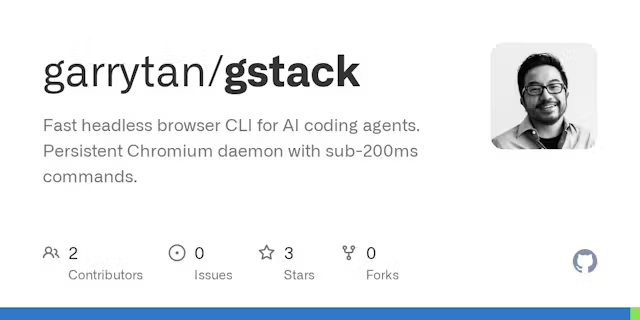
The project was introduced by Garry Tan with the idea that AI-assisted development becomes far more reliable when product planning, engineering review, QA testing, and shipping are separated into structured workflows rather than handled through a single prompt.
Rather than replacing Claude Code with another AI model layer, gstack acts as a workflow system on top of it. It packages commands, configurations, and operational modes that guide the AI’s behavior across different phases of development.
Role-Based AI Personas
One of the defining characteristics of GStack is its role-based AI persona system.
Instead of issuing a generic prompt to the AI, developers interact with custom slash commands that assign a specific role to the model. Each role narrows the AI’s focus to a particular responsibility.
This approach helps simulate a real development team where different specialists handle different aspects of a project.
Typical roles include:
- CEO / Product Visionary – focuses on product goals, scope, and user value
- Engineering Manager – handles architecture decisions and technical planning
- Engineer – implements production-ready code
- QA Engineer – identifies edge cases and validates system behavior
- Release Manager – manages versioning, changelogs, and releases
- DevOps Engineer – configures infrastructure and deployment pipelines
By narrowing the scope of each interaction, gstack encourages the AI to produce more focused and contextually relevant outputs.
The Core gstack Commands
The system exposes a set of slash commands that correspond to these roles.
These commands act as operational modes for the AI.
Examples include:
/gstack:ceo
Defines the product vision, scope, and strategic goals before development begins.

/gstack:eng-manager
Focuses on architecture planning, technical decisions, and engineering reviews.

/gstack: engineer
Implements the requested functionality in accordance with project conventions and coding standards.

/gstack:qa
Analyzes system behavior, identifies edge cases, and generates test coverage.

/gstack:release-manager
Prepares releases, generates changelogs, and ensures release readiness.

/gstack:devops
Handles infrastructure setup, CI/CD configuration, and deployment workflows.
This command-driven structure allows Claude Code to operate like a multi-role engineering team rather than a single coding assistant.
Structured Workflow for AI Development
Gstack’s workflow is designed to mirror how high-performing engineering teams operate.
A typical flow might look like this:
- Product strategy defined using the CEO role
- Architecture planning handled by the engineering manager
- Feature implementation by the engineer role
- Testing and validation by QA
- Release preparation by the release manager
- Infrastructure and deployment managed by DevOps
This structured pipeline introduces clear checkpoints during development, helping teams maintain consistency and reduce the risk of poorly reviewed AI-generated code entering production.
Why This Approach Improves AI Output
The role-based workflow provides several advantages.
Improved Output Quality
When the AI focuses on a single responsibility—such as architecture planning or QA testing—it tends to produce more precise and relevant outputs.
Reduced Context Overload
Instead of loading the AI with an entire project context in a single prompt, each role operates with a narrower scope, reducing prompt complexity and improving reasoning.
Faster Development Velocity
Routine tasks such as:
- drafting architecture plans
- generating test cases
- writing changelogs
- preparing releases
can be automated within structured workflows, allowing developers to focus on higher-level design decisions.
Requirements and Installation
Gstack is designed to work directly with Claude Code, which means developers must have access to the Anthropic ecosystem.
Typical requirements include:
- An active Anthropic API account
- a terminal development environment (Linux, macOS, or WSL on Windows)
- Claude Code installed locally
Installation typically involves cloning the repository and placing the configuration files into the Claude command directory, such as:
~/.claude/commands/
Once installed, the custom slash commands become available inside Claude Code, enabling developers to activate the different operational roles defined by gstack.
What Is Goose AI? & How It Works
Goose AI is an open-source AI development agent designed to automate complex engineering tasks. Unlike traditional chat-based coding assistants that primarily suggest code snippets, Goose operates as an agentic system that can actively interact with a developer’s environment to complete multi-step workflows.
The project was developed by Block Inc. and is designed for developers who want AI to go beyond simple code generation and take part in the broader software development process.
Instead of acting as a passive assistant, Goose functions more like an autonomous development agent that can plan tasks, modify files, run commands, and troubleshoot errors.
An Agentic Approach to Development
The core idea behind Goose is agent-driven automation.
Rather than waiting for a developer to request individual code snippets, the system attempts to solve entire engineering tasks by breaking them down into smaller steps and executing them automatically.
For example, a developer might give Goose a goal such as:
- create a new component
- write tests for it
- install dependencies
- Update the project configuration
Goose then attempts to plan and execute the full workflow, interacting with local tools and system resources as needed.
This makes it closer to an AI development agent than a traditional code assistant.
Local-First and Flexible Model Support
One of Goose’s defining features is its local-first architecture.
Instead of running entirely as a cloud service, Goose typically runs on the developer’s machine and allows users to connect their own large language model providers.
This “bring your own key” approach gives developers flexibility to choose between models such as:
- Anthropic models
- OpenAI models
- locally hosted models via Ollama
Because Goose runs locally, it can interact directly with the developer’s environment, repository, and command-line tools.
The Agentic Execution Loop
Goose operates through what is often described as an agentic loop, which repeatedly plans, executes, and evaluates actions until a task is completed.
A simplified version of this loop works as follows.
- User Prompt or Goal
The developer provides a task through a CLI or desktop interface.
Example goals might include:
- “Create a new React component with tests.”
- “Refactor the authentication service.”
- “Add API integration for payments.”
- Model Planning
Goose sends the request to a connected language model, which generates a step-by-step plan for completing the task.
This plan may include:
- creating files
- editing code
- running commands
- interacting with external services
3. Tool Execution via MCP
Goose then executes those steps using tools connected through the Model Context Protocol.
These tools allow the agent to interact with the local development environment.
Typical tool interactions include:
File Editor
Creates or modifies project files.
Terminal Access
Runs commands such as:
- git operations
- dependency installation
- test execution
Browser or API Access
Allows the agent to interact with external services or documentation.
- Self-Correction and Iteration
If a tool execution fails—such as a build error or failed test—the agent analyzes the error message and attempts a new solution.
This self-correction mechanism allows Goose to troubleshoot issues autonomously and continue working toward the original goal.
Multi-Model Execution Strategy
Another interesting capability of Goose is its multi-model architecture.
Developers can configure different models for different roles in the workflow.
For example:
- A lead model may handle high-level planning
- A worker model may perform faster execution tasks
This approach allows teams to balance performance, cost, and reasoning ability depending on the complexity of the task.
The Core Difference: Governance-Driven Workflows vs Autonomous Coding Agents
At first glance, Gstack and Goose AI may appear similar. Both integrate large language models into software development workflows and aim to accelerate engineering productivity.
However, their core philosophies are fundamentally different.
The distinction lies in how each system approaches AI-assisted development.
One focuses on structured governance, while the other focuses on autonomous task execution.
Goose AI: Autonomous Development Agent
Goose is designed around the idea of AI autonomy.
Once a developer provides a goal, Goose attempts to complete the entire workflow independently by:
- planning the task
- editing code files
- running terminal commands
- installing dependencies
- fixing errors
- iterating until the task is complete
Because it operates through an agentic loop, Goose behaves more like an automated engineering assistant that can interact with the development environment.
This makes it powerful for tasks such as:
- rapid prototyping
- multi-step code generation
- automated troubleshooting
- development experimentation
However, this autonomy also means that workflow structure is relatively flexible, and the AI may generate code without explicit role boundaries or formal review checkpoints.
Gstack: Governance-First AI Development
Gstack approaches AI development from a different direction.
Instead of allowing the AI to operate as a single autonomous agent, the framework separates development into distinct operational modes, each representing a stage of the engineering lifecycle.
These stages include:
- product planning
- engineering architecture review
- implementation
- quality assurance
- release preparation
- deployment
Each stage is triggered by role-specific commands that guide how the AI reasons about the task.
This structure introduces governance into AI-assisted development, ensuring that important activities such as architecture review and QA testing are not skipped.
Why Governance Matters for Engineering Teams
Autonomous AI coding agents can dramatically accelerate development, but they also introduce several risks for teams managing complex codebases.
Without clear boundaries, AI-generated code may:
- bypass architectural conventions
- introduce inconsistent design patterns
- skip formal testing steps
- create difficult-to-maintain technical debt
Large engineering organizations typically rely on structured processes such as:
- architecture reviews
- code reviews
- QA validation
- release management
Gstack attempts to bring those organizational practices into AI workflows by treating them as separate operational modes rather than optional steps.
Two Different Design Philosophies
The contrast between the two systems can be summarized simply.
Goose AI
- autonomous AI agent
- goal-driven execution
- interacts directly with the development environment
- optimized for speed and automation
Gstack
- structured AI workflow framework
- role-based operational modes
- introduces planning, review, QA, and release stages
- optimized for governance and engineering discipline
Both approaches can accelerate development, but they are optimized for different types of teams and development environments.
Autonomous agents tend to work well for rapid experimentation and prototyping, while governance-driven workflows are often better suited for production systems and larger engineering organizations.
Gstack vs Goose AI – Feature Comparison
While both Gstack and Goose AI aim to improve developer productivity using AI, their capabilities and design priorities differ significantly.
Goose focuses on autonomous execution, allowing the AI to perform multi-step development tasks directly inside the local development environment. Gstack, on the other hand, focuses on structured development workflows, separating planning, engineering review, QA, and release preparation into clearly defined operational modes.
The comparison below highlights how the two systems differ across key areas of AI-assisted development.
| Feature | Gstack | Goose AI |
|---|---|---|
| Primary Design Philosophy | Governance-driven AI workflow | Autonomous AI coding agent |
| Development Structure | Role-based operational modes | Agentic loop execution |
| AI Interaction Model | Slash commands for specific roles | Goal-driven autonomous tasks |
| Planning & Architecture Review | Built-in planning and engineering review stages | Limited structured planning |
| Code Generation | AI-assisted implementation within defined workflows | Autonomous code generation |
| Tool Interaction | Works through Claude Code workflows | Direct interaction with local tools and environment |
| QA Integration | Dedicated QA workflow for testing and validation | Testing handled through agent execution |
| Browser Automation | Persistent browser runtime for testing flows | Can interact with tools via MCP |
| Governance Controls | Strong role boundaries and workflow stages | Flexible but less structured |
| Best Use Case | Structured development and engineering teams | Rapid automation and experimentation |
When Should You Use Goose AI?
For developers looking to automate complex engineering tasks, Goose AI can be a powerful tool. Its agent-based architecture is designed to execute multi-step workflows with minimal manual intervention.
Because Goose operates through an autonomous planning-and-execution loop, it works best in situations where speed, experimentation, and automation are the primary goals.
Goose AI works well when:
You want rapid prototyping
Goose is well-suited for quickly testing new ideas, generating boilerplate code, and creating experimental features without spending time manually wiring together every step.
You want an AI agent to execute tasks end-to-end
Since Goose can interact with local tools such as file editors, terminals, and APIs, it can handle workflows like:
- creating files
- installing dependencies
- running tests
- fixing errors
This makes it useful for developers who want an AI assistant that behaves more like an autonomous operator than a simple code-suggestion tool.
You are experimenting with agentic development workflows
Many developers exploring AI-driven engineering systems are interested in agents that can plan, execute, and iterate on tasks automatically. Goose fits well into this experimental environment.
You are working on smaller projects or individual development environments
Because Goose emphasizes autonomy rather than governance, it tends to work best in:
- individual developer workflows
- startup prototypes
- experimental AI coding setups
In these environments, flexibility and speed are often more valuable than strict process control.
When Should You Use Gstack?
While Goose emphasizes autonomy, Gstack is designed for teams that want to introduce structure and governance into AI-assisted development.
Instead of allowing the AI to operate as a single autonomous agent, Gstack separates development activities into clearly defined operational modes that mirror real engineering roles.
Gstack works best when:
Your team needs structured development workflows
Gstack introduces distinct phases such as:
- product planning
- engineering architecture review
- implementation
- QA testing
- release preparation
This separation helps ensure that important development steps are not skipped when AI is involved.
You want stronger engineering governance
Large codebases and production systems require safeguards such as:
- architecture review
- code review discipline
- QA validation
- release readiness checks
Gstack’s role-based commands help enforce these processes inside AI workflows.
You are building production systems
Teams working on complex applications often need AI assistance while still maintaining:
- engineering standards
- architectural consistency
- testing coverage
- controlled releases
The workflow structure in Gstack is designed to align AI-generated work with those requirements.
Your organization wants AI to behave like a development team
One of Gstack’s most interesting ideas is that AI should not behave like a single general-purpose assistant. Instead, it should behave like a team of specialists, each responsible for a specific part of the development lifecycle.
By assigning roles such as product strategist, engineer, QA tester, and release manager, the framework encourages a more disciplined approach to AI-assisted development.
Final Verdict: Gstack vs Goose AI — Which One Should You Choose?
When comparing Goose AI and Gstack, the key difference lies in how AI is integrated into the software development lifecycle.
Both tools aim to improve developer productivity, but they address different problems.
When Goose AI is the better fit
Goose AI focuses on autonomous execution. It acts like an AI agent capable of planning tasks, interacting with tools, and executing development steps with minimal human intervention.
This approach is particularly useful for:
- rapid prototyping
- experimenting with agent-based development workflows
- individual developers or small teams
- automating repetitive development tasks
Developers exploring autonomous AI agents may find Goose AI valuable for accelerating experimentation and reducing manual development effort.
However, for organizations that require strong engineering governance and architectural oversight, fully autonomous agents may introduce challenges.
When Gstack is the better fit
Gstack focuses on structured AI-assisted development workflows rather than autonomous task execution.
The framework organizes development into phases that mirror traditional engineering roles, including planning, architecture review, development, and testing.
This structure can benefit:
- engineering teams working on production systems
- organizations with defined development processes
- Teams that want to maintain planning and QA discipline when using AI
By emphasizing process and workflow structure, Gstack helps ensure that AI participation aligns more closely with established engineering practices.
When teams need stronger governance and architectural control
For organizations where governance, transparency, and architectural alignment are critical, platforms like CodeConductor may provide a more integrated approach.
Instead of focusing only on autonomous agents or workflow organization, CodeConductor combines:
- prompt-driven application generation
- architectural system design
- AI governance controls
- transparency into AI-generated structures
This allows engineering teams to accelerate development while maintaining oversight over how AI contributes to application architecture and system design.
Summary
- Goose AI is best suited for autonomous coding experiments and rapid prototyping.
- Gstack is better suited for teams that want structured workflows around AI-assisted development.
- CodeConductor is designed for teams that require AI-driven development with stronger governance, transparency, and architectural consistency.
Choosing the right tool ultimately depends on whether your priority is autonomous experimentation, structured workflows, or governed application generation.
FAQs
What is Goose AI used for?
Goose AI is an autonomous coding agent designed to plan and execute development tasks. It can interact with tools such as terminals, file systems, and APIs to generate code, run commands, and iterate on development problems.
What is Gstack?
Gstack is a workflow framework that structures AI-assisted development into phases such as planning, architecture review, development, and testing. It helps engineering teams maintain development discipline while using AI tools.
Why do engineering teams care about AI governance?
AI governance ensures that AI systems adhere to organizational rules governing development practices, data usage, and architectural standards. Governance helps maintain consistency, reliability, and transparency in AI-assisted development.
Which AI development tool is best for enterprise teams?
Enterprise teams often prioritize governance, transparency, and architectural alignment when adopting AI development tools. Platforms that combine AI automation with structured development controls—such as CodeConductor—can be better suited for these environments.

Founder CodeConductor