Universal Commerce Protocol (UCP): The Future of Ecommerce AI Tools | CodeConductor
AI App Development
Universal Commerce Protocol (UCP): The Future of Ecommerce AI Tools – CodeConductor
The Universal Commerce Protocol (UCP) is an open standard that enables AI agents to discover products, initiate checkout, and complete purchases through a single, standardized integration. UCP removes the need for custom commerce integrations across platforms, allowing merchants to expose their...
Paul Dhaliwal
Founder & Chief Executive Officer · Updated Jun 10, 2026·11 min read
What You'll Learn
4 key concepts covered
1How shopping is shifting from web pages to AI agents.
2Why traditional ecommerce integrations break in conversational AI environments.
3What UCP is and how it standardizes AI-native checkout.
4How UCP enables secure purchases while merchants remain Merchant of Record.
Commerce is no longer starting on websites.
Today, buyers are discovering products inside AI conversations, asking questions, comparing options, and making decisions without ever visiting a traditional storefront. From search-powered AI experiences to chat-based assistants, the entire shopping journey is shifting from pages to agents.
But while discovery has moved into AI, checkout hasn’t kept up.
Most e-commerce systems are still built around web pages, plugins, and brittle integrations. They weren’t designed for AI agents that need to:
UCP introduces a standardized way for AI agents to discover products, initiate checkout, and complete purchases, securely and at scale. It’s the foundation that enables AI-native commerce.
And as agentic shopping becomes mainstream, a new category is emerging: agentic commerce platforms, systems that don’t just enable checkout, but orchestrate intelligent, end-to-end buying experiences across merchants, tools, and payment providers.
This is where CodeConductor comes in.
What Is the Universal Commerce Protocol (UCP)?
The Universal Commerce Protocol (UCP) is an open, standardized protocol designed to enable agentic commerce, where AI agents can discover products, negotiate capabilities, and complete purchases on behalf of users.
At a high level, UCP gives AI systems a common language for commerce.
Instead of every AI platform building custom integrations with every retailer, payment provider, or service, UCP collapses that complexity into a single, reusable abstraction layer.
In practical terms, UCP allows:
AI agents to discover what a business can do (browse products, apply discounts, check out)
Businesses to expose their commerce capabilities once, in a standardized way
Payments to be executed securely, with clear user consent and verification
Merchants to remain fully in control as the Merchant of Record
UCP was developed by Google in collaboration with major commerce leaders like Shopify, Etsy, Walmart, and Stripe, signaling a broader industry shift toward AI-first buying experiences.
What makes UCP especially powerful is that it works with existing commerce infrastructure. Merchants don’t need to rebuild their stores or migrate platforms. UCP simply sits on top of current systems, exposing standardized capabilities that AI agents can understand and use.
In short:
UCP is not a checkout UI
UCP is not a marketplace
UCP is the protocol that makes AI-native checkout possible
It defines how commerce happens in AI-driven environments, across search, chat, and agent-based experiences.
Why Traditional Ecommerce Infrastructure Breaks in AI
Traditional e-commerce was built for a page-based world.
Product discovery happens on websites. Checkout happens through forms. Integrations are handled via plugins, SDKs, or custom APIs. This model works when humans are clicking through pages, but it starts to break down when AI agents become the interface.
Most ecommerce systems rely on point-to-point integrations. If you want to sell on a new surface, another marketplace, a new app, or an AI assistant, you often need a brand-new integration. Multiply that across platforms, and you end up with an N×N problem: every new surface requires custom work.
AI agents don’t work that way.
Agents need to:
Discover products dynamically
Understand what actions a business supports
Compare options across multiple stores
Initiate checkout without hard-coded flows
Operate inside conversational contexts
Page-based systems, plugins, and SDKs weren’t designed for this level of flexibility.
As a result, brands face a growing gap:
Discovery is happening inside AI
Checkout is still trapped on websites
Without a standardized way to expose commerce capabilities, AI experiences become brittle, incomplete, or limited to simple redirects. This leads to lost intent, broken flows, and missed revenue, right when users are ready to buy.
This is the core problem UCP addresses: standardizing how commerce works for agents.
But standardization alone isn’t enough.
To actually deliver real-world AI checkout experiences, something else is required, intelligence, orchestration, and workflow control. That’s where the next layer comes in.
How UCP Enables AI-Native Checkout
UCP changes checkout by making it agent-native, not page-native.
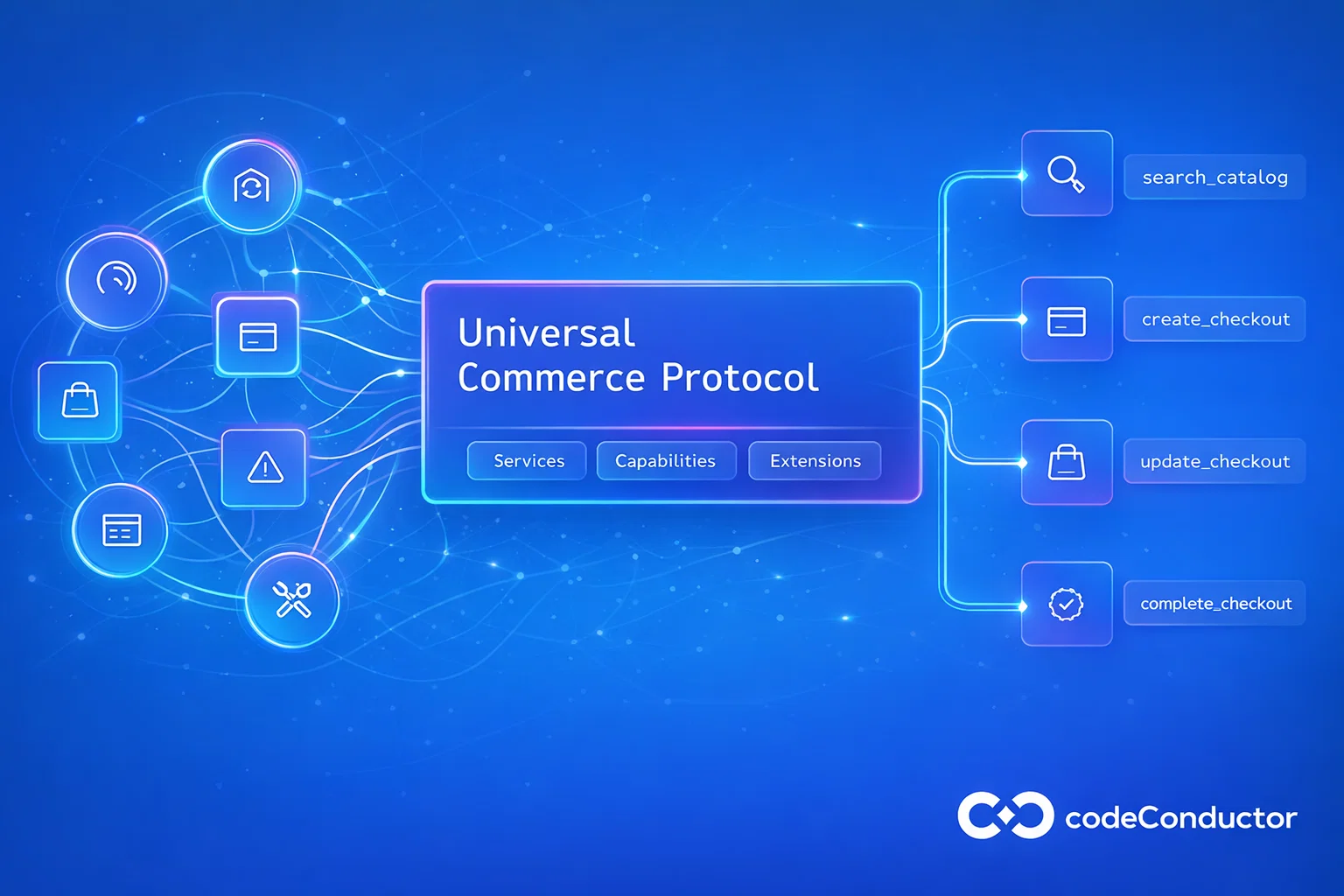
Instead of hard-coded flows or redirects to websites, UCP allows AI agents to interact with commerce systems through clearly defined capabilities, such as product discovery, checkout, discounts, and fulfillment, using a standardized protocol.
Here’s how AI-native checkout works with UCP:
1. Capability Discovery
Businesses publish a simple, machine-readable profile that declares:
What commerce actions they support
How agents can invoke those actions
Which payment methods and handlers are available
This allows AI agents to dynamically discover what a merchant can do, without prebuilt integrations.
2. Checkout Sessions Inside Conversations
Once an agent knows a merchant supports checkout, it can:
Create a checkout session programmatically
Add line items, quantities, and buyer information
Update the session in real time (pricing, discounts, fulfillment options)
All of this happens inside the AI conversation, without breaking user context.
3. Secure, Verifiable Payments
UCP separates:
Payment instruments (what the user pays with)
Payment handlers (how the payment is processed)
This design allows:
Secure tokenized payments
Cryptographic proof of user consent
Compatibility with existing wallets and payment providers
Importantly, the merchant remains the Merchant of Record, preserving trust, compliance, and ownership.
4. Extensible Commerce Logic
UCP is built with extensions in mind.
That means checkout can be enhanced with:
Discounts and promotions
Fulfillment logic
Identity linking
Order lifecycle updates
All without changing the core protocol.
The result is a checkout experience that feels natural in AI:
No redirects
No broken flows
No loss of intent
Users go from question → decision → purchase in one continuous interaction.
However, while UCP defines how checkout works at the protocol level, it intentionally avoids defining how decisions are made or how workflows are orchestrated.
And that’s the gap we’ll explore next.
Get insights in your inbox!!
Weekly tips on building smarter apps. Join 8,200+ founders and builders.
No spam. Unsubscribe anytime. We respect your privacy.
What UCP Does Not Solve (And Why That Matters)
The Universal Commerce Protocol is intentionally focused.
It standardizes how commerce actions are exposed and executed, but it does not attempt to define how AI agents think, decide, or coordinate complex workflows. That’s by design.
UCP does not handle:
Agent memory: UCP doesn’t remember users, preferences, or past interactions across sessions.
Business logic or decision-making: There’s no logic for comparing products, choosing vendors, or optimizing outcomes.
Multi-merchant orchestration: UCP enables checkout with a merchant, but not coordination across multiple stores.
Workflow control: It doesn’t define when to pause for human approval, retry steps, or branch flows.
Post-checkout automation: UCP doesn’t manage CRM updates, support handoffs, refunds, or lifecycle workflows.
This is an important distinction.
UCP is a protocol, not a platform.
On its own, it enables AI checkout, but it doesn’t deliver intelligent commerce experiences. Without an orchestration layer, teams are left stitching together logic, memory, and workflows manually on top of UCP.
That’s where most implementations struggle.
To turn UCP into something brands can actually deploy at scale, you need a system that:
Coordinates agent behavior
Maintains context across conversations
Orchestrates checkout, discounts, fulfillment, and follow-up
Integrates with the rest of the business stack
This missing layer is exactly what agentic commerce platforms are built to provide.
As AI agents become the new storefronts, commerce needs more than a protocol. It needs intelligence, coordination, and control.
CodeConductor is an agentic commerce platform designed to sit between AI agents and commerce systems, turning UCP-powered checkout into real, production-ready buying experiences.
Where UCP defines how commerce actions are executed, CodeConductor defines when, why, and in what order they occur.
At its core, CodeConductor provides the missing orchestration layer that allows teams to:
Coordinate AI-driven discovery and checkout flows
Maintain context and memory across user sessions
Control decision logic, approvals, and fallbacks
Integrate commerce with the rest of the business stack
Instead of hard-coding logic into agents or rebuilding commerce systems, teams use CodeConductor to compose intelligent workflows on top of UCP.
This makes AI checkout:
Stateful instead of stateless
Intent-aware instead of transactional
Flexible instead of brittle
From a founder or ecommerce brand’s perspective, CodeConductor acts as the commerce brain behind AI experiences, connecting agents, merchants, and payment providers through a single, orchestrated system.
In the next sections, we’ll break down exactly how CodeConductor works in practice:
As a UCP orchestrator
As an agent commerce engine
And as an AI checkout workflow builder
CodeConductor as a UCP Orchestrator
At a technical level, CodeConductor acts as a UCP orchestrator, the system that coordinates how AI agents interact with UCP-enabled merchants and payment providers.
Rather than forcing agents to manage protocol details themselves, CodeConductor handles the full lifecycle of UCP interactions in a structured, reliable way.
To deliver truly differentiated AI commerce experiences, agents need memory, reasoning, and decision-making power. That’s where CodeConductor’s role expands next.
CodeConductor as an AI Checkout Workflow Builder
For founders and ecommerce brands, the real challenge isn’t just enabling AI checkout, it’s controlling it.
CodeConductor solves this by providing a workflow-based approach to AI commerce, allowing teams to design, test, and deploy checkout logic without rebuilding their existing systems.
Instead of writing custom code for every scenario, teams use CodeConductor to visually compose AI-native checkout workflows that run on top of UCP.
Visual, No-Code Commerce Logic
With CodeConductor, you can define:
When an agent should initiate checkout
How products are selected or bundled
When discounts apply
Where approvals are required
What happens after purchase
All through configurable workflows that are easy to iterate and scale.
Human-in-the-Loop or Fully Autonomous
Not every transaction should be fully autonomous.
CodeConductor allows teams to:
Pause checkout for user confirmation
Route decisions to human operators
Enforce spending limits or compliance checks
This makes AI checkout safe, controllable, and adaptable to real business needs.
Post-Checkout Automation
Checkout isn’t the end of the journey.
CodeConductor workflows can automatically:
Update CRM systems
Trigger fulfillment or logistics
Notify support teams
Handle refunds, exchanges, or follow-ups
This turns AI checkout into an end-to-end commerce system, not a disconnected transaction.
Next, we’ll look at how this all comes together for ecommerce brands, especially those running on Shopify.
Why Agentic Commerce Increases Discovery and Conversion
Traditional ecommerce funnels are built around navigation and friction.
Users search, click, browse, compare, and eventually, sometimes, check out. Every step introduces drop-off. Even high-intent buyers often abandon the journey before completing a purchase.
Agentic commerce flips this model.
Instead of forcing users through pages, AI agents meet buyers at the moment of intent, inside conversations where decisions are already being made.
This dramatically expands where and how brands are found.
Fewer Steps, Less Friction
Because checkout happens inside the AI experience:
There are no redirects
No form-heavy flows
No context switches
Users move seamlessly from interest to purchase, which significantly improves conversion rates.
Personalization That Actually Works
AI agents powered by CodeConductor can:
Remember preferences
Adjust recommendations in real time
Offer bundles or alternatives dynamically
This level of personalization is difficult to achieve with static storefronts.
Trust and Control Are Preserved
Even though the experience feels conversational, the underlying commerce is still:
Secure
Verifiable
Merchant-controlled
UCP ensures merchants remain the Merchant of Record, while CodeConductor ensures logic, approvals, and compliance remain under business control.
Together, these factors create a buying experience that feels effortless for users, and more effective for brands.
Next, we’ll cover how founders and ecommerce teams can actually get started.
In a Nutshell: Why CodeConductor Powers the Future of AI Commerce
Commerce is entering a new phase.
Discovery, decision-making, and checkout are moving out of websites and into AI-driven conversations. In this world, traditional ecommerce tools fall short, not because they’re broken, but because they were never designed for agents.
The Universal Commerce Protocol (UCP) lays the foundation by standardizing how AI systems interact with merchants and payment providers.
But protocols alone don’t create great experiences.
CodeConductor provides the missing layer:
Orchestrating UCP-powered checkout
Powering intelligent, stateful agents
Enabling flexible, controllable AI commerce workflows
Connecting Shopify and other commerce systems to AI-native surfaces
Together, UCP and CodeConductor turn AI agents into real storefronts, capable of discovering products, completing purchases, and scaling across platforms.
UCP defines the rules of agentic commerce. CodeConductor makes it real.
Ready to Build Without Code?
See how CodeConductor helps enterprises ship faster while staying compliant.
The Universal Commerce Protocol (UCP) is an open standard that allows AI agents to discover products, initiate checkout, and complete purchases using a single, standardized integration. Instead of building custom connections for every platform, UCP enables merchants to expose commerce capabilities once, making them accessible across AI-powered experiences like search, chat, and assistants.
Is UCP only for Google or Gemini experiences?
No. While Google provides the first reference implementation of UCP for AI-powered search and assistants, UCP is vendor-neutral and platform-agnostic. It can be used across any AI agent, app, or conversational interface that supports agentic commerce.
Key Takeaways
4 essential insights
Optimize for AI-led discovery, but enable checkout inside conversations.
Adopt UCP to standardize product discovery, discounts, inventory, and checkout.
Replace brittle point-to-point integrations with a reusable commerce abstraction layer.
Expose commerce capabilities once, keeping merchants in control as Merchant of Record.
Paul Dhaliwal is a tech innovator and Founder of CodeConductor, an open-source no/low-code platform. With 10+ years of experience in AI and scalable development, Paul focuses on crafting intelligent solutions that drive real-world value. A firm believer in the mantra "Eat, Sleep, Code, Repeat," he balances his passion for software with a love for travel and family.
⚡
Build your app
No coding. No designers. Just describe what you want and watch AI build it.