Is Anthropic Profitable in 2026? Claude Code’s Role in Q2 Growth | CodeConductor
Ai Model
Is Anthropic Profitable in 2026? Claude Code’s Role in Q2 Growth
Claude Code has quickly grown into one of Anthropic’s most important commercial products, reaching a multibillion-dollar annualized revenue run rate. This article examines how much Claude Code may contribute to Anthropic’s broader revenue growth and whether it can really be linked to the company’s reported positive adjusted operating income. It also explores Anthropic’s enterprise and API revenue mix, the rapid expansion of the AI coding market, and Claude Code’s role within it. See what the latest 2026 revenue figures reveal about Anthropic’s business model, enterprise AI adoption, and the economics behind AI coding.
Paul Dhaliwal
Founder & Chief Executive Officer · Updated Aug 20, 2026·12 min read
What You'll Learn
4 key concepts covered
1Why Q2 2026 adjusted operating income is not proof of net profitability.
2How Claude Code’s $2.5B run-rate aligns with overall revenue growth.
3What annualized run rate, recognized revenue, and adjusted operating income mean.
4How Anthropic’s 2026 revenue acceleration reflects enterprise and coding demand.
Is Claude Code making Anthropic profitable, and how much does it actually contribute to the company’s revenue growth? The question has become increasingly relevant as Claude Code moves from a developer tool into one of Anthropic’s fastest-growing commercial products, while enterprise adoption of Claude, API usage, agentic coding, and AI software development continue to accelerate.
The short answer is that Claude Code appears to be a significant contributor to Anthropic’s commercial growth, but there is no public evidence that Claude Code alone made Anthropic profitable. Anthropic reported more than $2.5 billion in Claude Code annualized run-rate revenue in February 2026, while preliminary financial documents reviewed by Bloomberg indicate that Anthropic recorded positive adjusted operating income in Q2 2026.
The larger story is the economics behind those numbers. Enterprise AI spending is growing rapidly, coding has emerged as one of generative AI’s biggest commercial use cases, and Anthropic appears particularly well positioned in both enterprise model usage and AI coding.
Is Anthropic Profitable in 2026?
The most accurate answer is that Anthropic reportedly recorded positive adjusted operating income in Q2 2026. That is an important financial milestone, but it should not be interpreted as proof of sustainable GAAP operating profitability or net profitability.
According to preliminary financial information reviewed by Bloomberg, Anthropic generated more than $11.5 billion in Q2 2026 revenue, up from $4.73 billion in Q1 2026 and $787 million in the comparable quarter a year earlier. The same documents showed positive adjusted operating income during Q2. Bloomberg noted that the figures were preliminary and could still be revised.
Earlier reporting cited by Reuters indicated that Anthropic had been expected to generate roughly $559 million in adjusted operating profit on at least $10.9 billion of Q2 revenue. That was a forecast rather than the subsequently reported preliminary result.
What Do Anthropic’s Financial Metrics Actually Mean?
Metric
Meaning
Annualized revenue run rate
A recent revenue pace extrapolated across 12 months
Recognized revenue
Revenue actually recorded during a specific accounting period
Adjusted operating income
An operating-income measure calculated after specified accounting adjustments
Net profit
Income remaining after operating expenses, financing costs, taxes, and other expenses
These distinctions matter because Anthropic’s $65 billion annualized revenue run rate does not mean it recognized $65 billion of revenue during 2026. Likewise, positive adjusted operating income in one quarter does not establish sustainable annual net profitability.
How Fast Is Anthropic’s Revenue Growing in 2026?
Anthropic’s revenue trajectory has accelerated sharply.
Period
Anthropic Revenue Metric
End of 2025
Approx. $9B annualized run rate
February 2026
$14B annualized run rate
April 2026
$30B+ annualized run rate
May 2026
$47B+ annualized run rate
Q2 2026
$11.5B+ preliminary quarterly revenue
End of July 2026
$65B+ annualized run rate
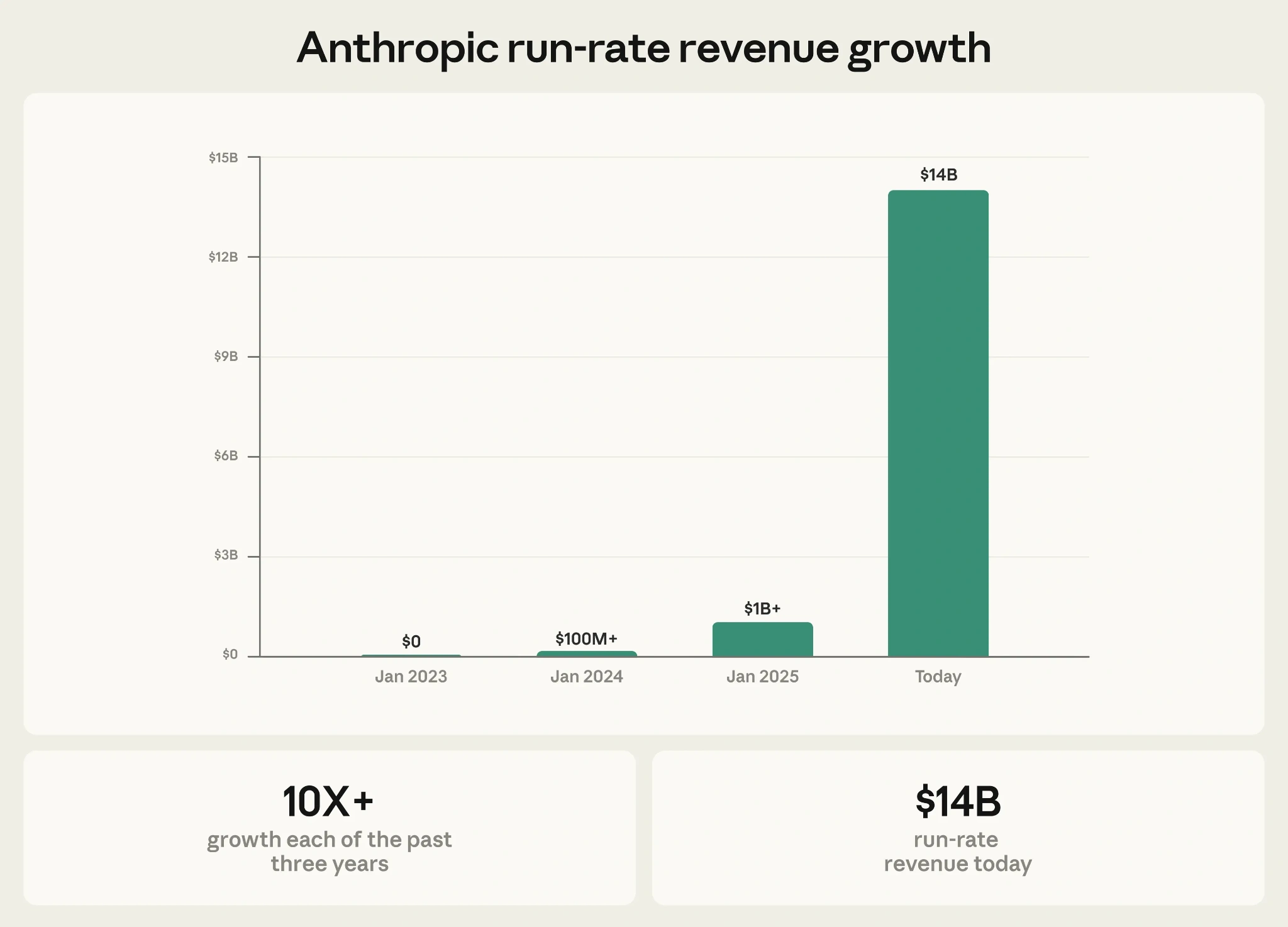
Anthropic said in February that its company-wide annualized revenue run rate had reached $14 billion, after growing more than tenfold annually in each of the previous three years.
By April, Anthropic reported that its annualized run rate had surpassed $30 billion, compared with approximately $9 billion at the end of 2025. It also said the number of business customers spending more than $1 million annually had doubled from more than 500 in February to more than 1,000 in less than two months.
Anthropic then reported that its annualized revenue run rate crossed $47 billion in May.
By the end of July, Bloomberg and Reuters reported that Anthropic’s annualized revenue run rate had exceeded $65 billion, based on financial information shared with investors.
That growth is company-wide. The public numbers do not provide a complete product-by-product breakdown of what portion came from Claude Code, Claude subscriptions, enterprise contracts, or API consumption.
Ready to Build Without Code?
See how CodeConductor helps enterprises ship faster while staying compliant.
Claude Code has become one of the strongest publicly disclosed examples of an AI coding product reaching multibillion-dollar scale.
Anthropic made Claude Code generally available in May 2025. By November 2025, only six months after general availability, Claude Code had reached $1 billion in annualized run-rate revenue.
The growth accelerated further in early 2026.
On February 12, Anthropic disclosed that:
Claude Code run-rate revenue had exceeded $2.5 billion;
weekly active Claude Code users had doubled since January 1;
business subscriptions had quadrupled since the start of 2026;
enterprise use represented more than half of Claude Code revenue.
These figures are particularly significant because Claude Code is not a mass-market social or entertainment product. It is a specialized developer tool tied directly to software engineering and enterprise workflows.
How Much of Anthropic’s Revenue Comes From Claude Code?
Anthropic has not published enough product-level financial data to calculate Claude Code’s exact share of recognized revenue or profit.
There is, however, one useful like-for-like comparison.
In February 2026:
Anthropic reported a $14 billion company-wide annualized revenue run rate.
Claude Code had a $2.5 billion-plus annualized run rate.
That means Claude Code’s disclosed run rate was equivalent to at least about 18% of Anthropic’s company-wide run rate at that point.
That does not mean Claude Code generated 18% of Anthropic’s Q2 recognized revenue or 18% of its operating income. It simply compares two annualized run-rate figures reported at approximately the same time.
Anthropic has not published a newer standalone Claude Code revenue figure comparable to its February disclosure. For that reason, claims that Claude Code reached an $8 billion run rate in May should be treated as estimates unless Anthropic independently confirms them.
What Actually Drives Anthropic’s Revenue?
Claude Code is important, but Anthropic’s broader business is heavily weighted toward enterprise customers and API usage.
Sacra estimates that Anthropic had more than 300,000 business customers as of October 2025, accounting for approximately 80% of revenue. Sacra also says enterprise and startup API calls drive the majority of Anthropic’s revenue through pay-per-token pricing.
That composition matters.
Traditional SaaS companies often grow primarily by selling more seats or increasing subscription prices. Anthropic has another growth mechanism: usage-based consumption.
When a company moves more workloads through Claude APIs, processes more tokens, embeds Claude into additional products, or expands AI usage across departments, Anthropic can generate more revenue without requiring a proportional increase in individual user seats.
Get insights in your inbox!!
Weekly tips on building smarter apps. Join 8,200+ founders and builders.
No spam. Unsubscribe anytime. We respect your privacy.
That creates two important commercial engines:
Enterprise and API consumption, where revenue can expand with workload volume.
Products such as Claude Code, which create intensive professional use cases and can expand across engineering organizations.
It would be inaccurate to say that all of Anthropic’s business revenue is metered API consumption, Claude Code, Claude for Work, and other products can use different commercial models. But usage-based enterprise AI is clearly a major component of Anthropic’s economics.
Why Has AI Coding Become Such a Big Business?
Claude Code is growing inside an AI coding market that expanded dramatically in 2025.
Menlo Ventures estimates that enterprises spent $37 billion on generative AI in 2025, more than three times the $11.5 billion spent in 2024. Of that, $19 billion went to AI applications.
Coding was the standout departmental use case.
Menlo estimates:
Category
2025 Enterprise Spend
Total generative AI
$37B
AI applications
$19B
Departmental AI
$7.3B
AI coding
$4B
At $4 billion, coding accounted for approximately 55% of departmental AI spending. Menlo describes coding as generative AI’s first true “killer use case.”
Even more striking is the rate of expansion: Menlo estimates AI coding spending rose from roughly $550 million in 2024 to $4 billion in 2025.
These are market estimates rather than audited industry totals, but they show why coding has become strategically important to model providers such as Anthropic, OpenAI, and Google.
Why Coding Monetizes So Well
Software development has several characteristics that make it particularly well suited to commercial AI.
First, companies already spend heavily on engineering. AI coding tools can compete for part of an existing technology budget rather than requiring businesses to invent an entirely new spending category.
Second, developer usage is frequent. An AI coding workflow may involve repeated cycles of repository analysis, code generation, debugging, testing, refactoring, and review.
Third, many outputs are verifiable. Code can compile or fail. Tests can pass or fail. A bug can be reproduced and fixed. A pull request can be reviewed.
Fourth, the value can often be connected to business outcomes. Faster feature delivery, fewer repetitive engineering tasks, shorter debugging cycles, and increased development velocity provide clearer economic signals than many general-purpose chatbot interactions.
Menlo’s research says 50% of developers in its survey use AI coding tools daily, rising to 65% at top-quartile organizations, while surveyed teams reported development-velocity gains of 15% or more. Those are Menlo survey findings, not universal performance guarantees.
Is Coding Becoming Anthropic’s Enterprise Advantage?
The strongest evidence that coding matters strategically to Anthropic comes from its estimated position in enterprise model spending.
Menlo Ventures estimates that Anthropic captured approximately 40% of enterprise LLM spend in 2025, compared with:
27% for OpenAI;
21% for Google.
Menlo estimates Anthropic’s enterprise LLM share increased from 24% in 2024 and 12% in 2023.
Its estimated position in coding is even stronger.
Anthropic’s Estimated Share of Enterprise AI Coding
Menlo estimates Anthropic held approximately 54% of enterprise coding-model spend, compared with 21% for OpenAI.
That was up from an estimated 42% six months earlier, with Menlo attributing much of the gain to Claude Code’s popularity.
This figure needs an important qualification.
It does not mean Claude Code itself owns 54% of the AI coding-tool market.
Menlo’s methodology estimates model-provider share based largely on production API usage and reported enterprise workloads. Claude models can therefore contribute to Anthropic’s coding share even when developers are using Claude through another application, API, cloud platform, or development environment.
Menlo Ventures is also an Anthropic investor, which is relevant when interpreting its market estimates. The figures remain useful, but they should be presented as Menlo’s estimates, not independently audited market-share statistics.
Claude Code Is Bigger Than a Standalone Developer Tool
Claude Code matters to Anthropic for more than its direct product revenue.
Businesses that begin with one Claude use case may expand into others. Anthropic itself says customers often begin with an API, Claude Code, or Claude for Work and then expand integrations across their organizations.
Coding can therefore serve as both a revenue stream and an entry point into larger enterprise relationships.
The pattern also aligns with broader enterprise AI adoption. Menlo found that individual users increasingly introduce AI products into organizations before centralized procurement takes over, with product-led growth accounting for an estimated 27% of AI application spending. Developers and technical teams were identified as particularly receptive to this bottom-up adoption model.
For Anthropic, Claude Code gives the company a product that sits directly inside one of the most valuable and frequently used professional AI workflows.
Can Claude Code Keep Driving Anthropic’s Growth?
Claude Code has strong momentum, but its current trajectory is not guaranteed to continue indefinitely.
Competition Will Intensify
Anthropic competes for developer workloads with OpenAI, Google, GitHub, AI-native development tools, and emerging coding-agent platforms.
Coding models are improving quickly, and developers can switch between models or use several tools depending on the task.
Anthropic’s current position therefore depends on continuing to perform well not only on benchmarks, but also in real development environments.
Enterprise Buyers Will Focus More on ROI
Rapid adoption is useful early evidence, but mature enterprise buyers will increasingly ask a harder question:
How much useful engineering output are we getting for the money we spend on AI?
This shifts attention from seats, prompts, and tokens toward outcomes such as:
faster development cycles;
completed engineering tasks;
code quality;
review requirements;
reliability;
security;
production impact.
Compute Economics Still Matter
Anthropic’s rapid revenue growth comes with substantial infrastructure requirements.
The company continues to expand compute capacity to meet demand, including large-scale agreements involving AWS, Google, Broadcom, Microsoft, NVIDIA, and other infrastructure partners. Anthropic explicitly said its May funding would help expand compute to support growing demand.
Reuters has also noted that investors are watching whether Anthropic’s revenue growth can continue to outpace its infrastructure and operating costs.
That makes profitability a question of both revenue growth and the cost of serving increasingly intensive AI workloads.
What Claude Code Reveals About the Future of Enterprise AI
Claude Code may be important beyond software development because it illustrates what a strong enterprise AI business model can look like.
That combination is fundamentally different from building a consumer chatbot and hoping engagement eventually converts into subscriptions.
Coding attaches AI directly to an expensive business function where companies can already measure output and allocate budgets.
Anthropic’s broader revenue structure reinforces this model. Its enterprise/API business can expand as workloads increase, while products such as Claude Code create new high-intensity workflows that generate additional demand.
The result is a business where usage, enterprise expansion, and specialized AI products can reinforce one another.
That may be one reason Anthropic’s revenue has scaled so quickly.
Claude Code Is Becoming a Major Part of Anthropic’s Growth Story
Claude Code does not prove that one developer product made Anthropic profitable.
What the available evidence does show is that Claude Code has become a multibillion-dollar commercial product inside one of the fastest-growing enterprise AI companies.
Its more than $2.5 billion annualized run rate represented a meaningful portion of Anthropic’s overall run rate in February 2026. Enterprise use already accounted for more than half of Claude Code revenue, while Menlo Ventures estimates that coding has grown into a $4 billion enterprise AI category and that Anthropic holds an unusually strong position in coding-model spending.
At the same time, Anthropic’s broader economics remain heavily enterprise-driven. API usage, business customers, and professional AI workloads give the company a revenue model that can expand as customers increase consumption, not simply as they add subscription seats.
So, is Claude Code making Anthropic profitable?
Not by itself, based on the evidence currently available. But Claude Code is clearly becoming one of the products that helps explain why Anthropic’s revenue growth, and the economics of enterprise AI coding, look so significant in 2026.
Frequently Asked Questions About Claude Code and Anthropic Revenue
Is Anthropic Profitable in 2026?
Anthropic reportedly recorded positive adjusted operating income in Q2 2026 based on preliminary financial documents. That does not establish sustainable GAAP operating profitability or net profitability.
Did Claude Code Make Anthropic Profitable?
There is no public evidence that Claude Code alone made Anthropic profitable. Claude Code is a significant growth product, but Anthropic’s company-wide results also include enterprise subscriptions, API consumption, Claude for Work, and other revenue sources.
How Much Revenue Does Claude Code Generate?
Anthropic reported more than $2.5 billion in Claude Code annualized run-rate revenue in February 2026, after the product reached $1 billion in November 2025.
How Much of Anthropic’s Revenue Comes From Claude Code?
Claude Code’s $2.5 billion-plus February run rate was equivalent to at least about 18% of Anthropic’s $14 billion company-wide run rate at the time. That is a run-rate comparison, not Claude Code’s share of recognized revenue or profit.
How Big Is the AI Coding Market?
Menlo Ventures estimates enterprises spent approximately $4 billion on AI coding in 2025, up from about $550 million in 2024. Coding represented roughly 55% of departmental AI spending in Menlo’s model.
What Is Anthropic’s AI Coding Market Share?
Menlo Ventures estimates Anthropic accounts for approximately 54% of enterprise coding-model spend, compared with 21% for OpenAI. This measures estimated model-provider spending and usage rather than Claude Code’s direct share of all AI coding software revenue.
What Is Anthropic’s Main Source of Revenue?
Third-party research from Sacra estimates that business customers accounted for approximately 80% of Anthropic’s revenue as of October 2025, with enterprise and startup API calls driving the majority of revenue through usage-based token pricing.
Key Takeaways
4 essential insights
Claude Code drives major commercial momentum, but profitability attribution remains unproven publicly.
Positive adjusted operating income in Q2 2026 is not GAAP profitability.
Annualized run-rate figures indicate pace, not revenue actually recognized in 2026.
Written by
Paul Dhaliwal
Founder & Chief Executive Officer
Paul Dhaliwal is a tech innovator and Founder of CodeConductor, an open-source no/low-code platform. With 10+ years of experience in AI and scalable development, Paul focuses on crafting intelligent solutions that drive real-world value. A firm believer in the mantra "Eat, Sleep, Code, Repeat," he balances his passion for software with a love for travel and family.
⚡
Build your app
No coding. No designers. Just describe what you want and watch AI build it.