Are AI agents accessing your website, consuming your APIs, and retrieving valuable content while your business bears the infrastructure costs?
AWS WAF AI traffic monetization enables businesses to charge compatible AI bots and agents for accessing digital resources through Amazon CloudFront using the x402 payment protocol.
Businesses can:
Identify automated traffic.
Enforce access policies.
Regulate request volumes.
Collect per-request payments in USDC.
For publishers, SaaS providers, and enterprises, the opportunity extends beyond bot blocking. It involves deciding which AI agents can access digital resources, under what conditions & at what cost.
Key Takeaways
AI agent traffic monetization: AWS WAF enables businesses to charge compatible AI agents for accessing CloudFront-delivered content, APIs & datasets.
AI agent identification: AWS WAF Bot Control classifies automated traffic, while Web Bot Authentication supports cryptographic identity verification.
Automated payments: The x402 protocol uses HTTP 402 responses to initiate machine-to-machine payments.
Flexible pricing: Businesses can configure base prices starting at 0.001 USDC per request for self-managed wallets and apply price multipliers from 1–100.
Selective access: Businesses can maintain free access for legitimate search crawlers while monetizing commercially valuable resources.
Payment settlement: AWS WAF delivers protected content after successful payment settlement when the resource retrieval succeeds.
Why Does AI Agent Traffic Require Different Bot Management Policies?
AI agent traffic requires differentiated bot management because automated clients perform different tasks, consume different resources & create different levels of commercial value.
Traditional bot management primarily distinguishes legitimate automated traffic from potentially malicious activity. AI traffic governance must also consider the purpose of each request and whether the requested resource should remain freely accessible.
AI traffic type | Primary purpose | Business consideration |
|---|
AI training crawlers | Collect content for model training | Content licensing and intellectual property |
AI search crawlers | Retrieve information for AI-powered search | Brand discovery and AI search visibility |
Autonomous AI agents | Interact with websites, APIs and digital services | Resource consumption and paid access |
Unverified automated clients | Perform unidentified automated activities | Security and unauthorized access risks |
Applying a single access policy to every AI bot can increase infrastructure costs, expose proprietary information, and restrict legitimate content discovery.
Businesses should therefore evaluate AI traffic according to four factors: identity, intent, resource value, and access permissions.
How Does AWS Identify, Control & Optimize AI Agent Traffic?
AWS supports AI traffic management through AWS WAF Bot Control, Web Bot Authentication, CloudFront Functions, and rate-based rules. Each capability addresses a different aspect of automated traffic governance.
AWS capability | Primary function |
|---|
AWS WAF Bot Control | Detects and classifies automated traffic |
Web Bot Authentication | Cryptographically verifies compatible bots |
CloudFront Functions | Customizes lightweight edge request processing |
AWS WAF rate-based rules | Regulates request frequency |
AWS WAF Monetize action | Enforces payment requirements |
How Does AWS WAF Verify AI Agent Identity?
AWS WAF Bot Control identifies and classifies automated traffic using request characteristics, behavioral signals, and bot-specific labels, helping businesses distinguish legitimate AI agents from potentially malicious or unauthorized bots.
Web Bot Authentication (WBA) enables compatible AI bots and agents to cryptographically verify their identities rather than relying solely on self-reported user-agent strings.
For CloudFront integrations, WBA requires an explicitly selected static version 4.0 or later of the AWS WAF Bot Control managed rule group (AWSManagedRulesBotControlRuleSet).
Businesses can monitor bot classifications, verification status, and request patterns through AWS WAF logs and Amazon CloudWatch to establish differentiated traffic management policies.
However, identity verification does not automatically establish access authorization. A verified AI agent may still lack permission to retrieve proprietary content, access sensitive datasets or invoke protected APIs.
While AWS WAF provides infrastructure-level bot identification and verification, CodeConductor helps engineering teams build governed AI applications with role-based access controls (RBAC), configurable business logic, and API integrations.
Combining infrastructure-level bot authentication with application-level authorization and enterprise AI application security practices helps businesses establish secure agent-to-application interactions without relying exclusively on edge-level traffic controls.
How Do CloudFront Functions Optimize Content Delivery for AI Agents?
Amazon CloudFront Functions enable lightweight request processing at the network edge. Businesses can use available request characteristics to customize how incoming requests are handled.
Potential AI traffic optimization approaches include:
Delivering interactive website experiences to human visitors.
Routing authorized AI agents to structured content representations.
Directing compatible clients to appropriate resource endpoints.
Reducing unnecessary processing for machine-oriented requests.
AWS also guides monetizing publisher content for AI agents, illustrating how businesses can deliver AI-oriented content representations through configured infrastructure and content processing pipelines.
These approaches require application-specific configuration and reliable visitor identification. CloudFront Functions do not automatically transform existing web pages into AI-optimized content.
Businesses should maintain consistency in substantive information across content representations to avoid deceptive cloaking practices.
How Can Businesses Rate-Limit AI Agent Requests?
AWS WAF rate-based rules control request frequency using configurable aggregation criteria, including IP addresses, HTTP headers, URI paths, and label namespaces.
Businesses can establish differentiated request limits for AI crawler categories, automated clients, and resource-intensive endpoints.
AWS WAF rate-based rules measure request volumes rather than actual CPU consumption, bandwidth usage, or API processing costs. Application-level controls may therefore be necessary for resource-based usage limits.
Rate limiting and monetization require separate rule configurations because AWS WAF rate-based rules do not support the Monetize action.
How Does AWS WAF Monetize AI Traffic Using x402?
AWS WAF AI traffic monetization enables content and API providers to charge compatible AI agents for accessing selected CloudFront-delivered resources.
AWS WAF evaluates incoming requests against monetization policies and initiates the x402 payment process when payment is required.
The feature supports monetization of resources such as articles, API endpoints, datasets, media assets, and data feeds.
How Does the x402 Payment Workflow Work?
The x402 payment protocol enables automated payments through HTTP-based interactions without conventional checkout processes.
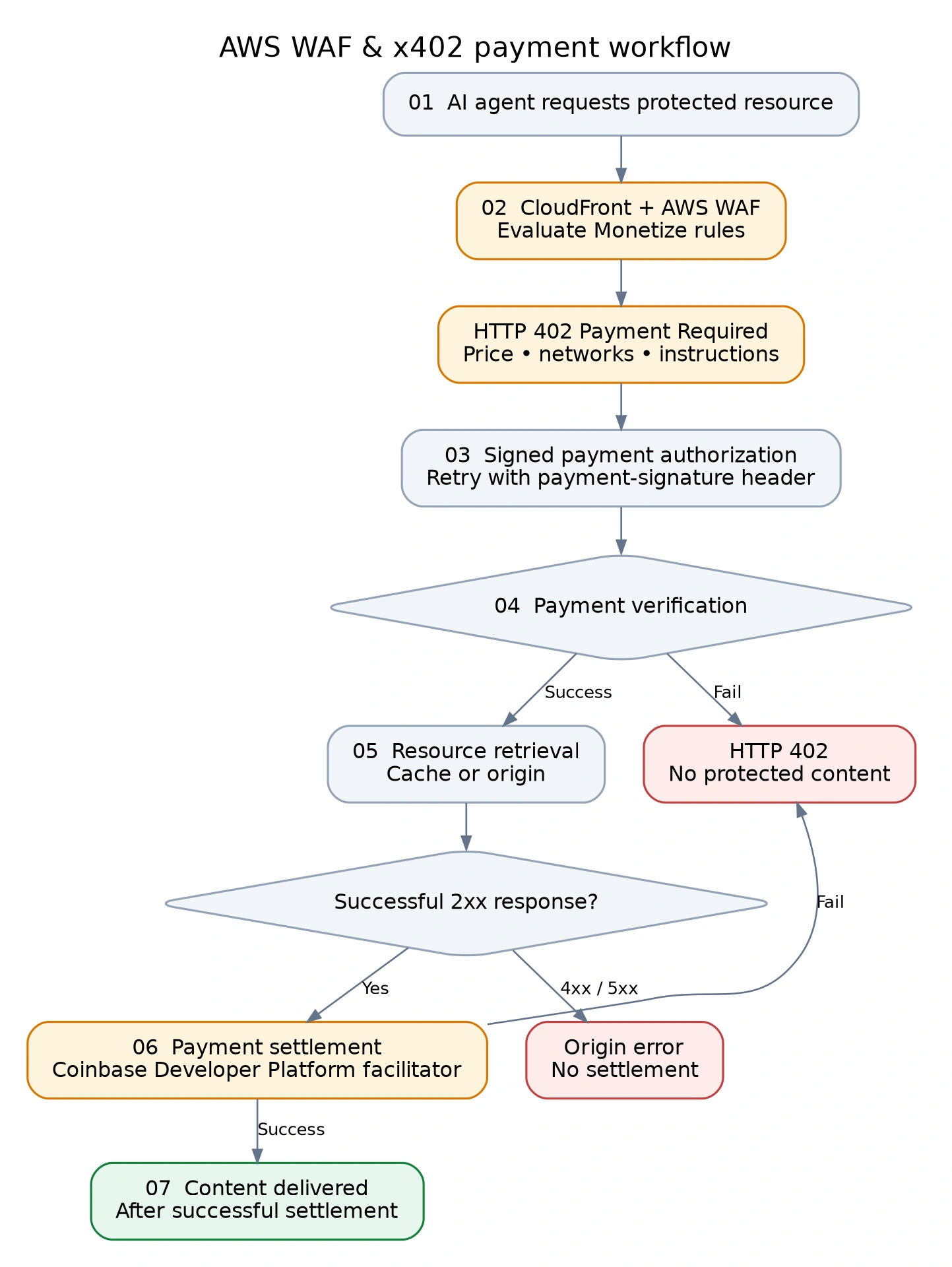
Figure 1. AWS WAF and x402 payment workflow for AI agent resource access. Verification or settlement failure results in HTTP 402; origin errors do not trigger settlement.
According to the official AWS WAF monetization workflow, the process follows seven stages:
Resource request: An AI agent requests a CloudFront-protected resource.
Payment challenge: AWS WAF responds with HTTP 402 when a Monetize rule matches and valid payment authorization is absent.
Payment authorization: The agent signs a payment authorization and resubmits its request using the payment-signature header.
Verification: AWS WAF validates the payment authorization and checks available funds.
Resource retrieval: The requested content is fetched after verification succeeds.
Settlement: A successful resource response triggers payment settlement through Coinbase Developer Platform's x402 facilitator.
Content delivery: The agent receives the resource and settlement confirmation after payment succeeds.
Failed verification or settlement prevents delivery of the protected content. An origin response with a 4xx or 5xx status code does not trigger payment settlement.
AWS WAF also supports single-use payment authorizations and eligible payment-identifier retries within a 15-minute window.
AWS WAF AI Traffic Monetization Architecture
AWS WAF and Amazon CloudFront form the core of AWS's edge-level AI traffic monetization architecture. Additional AWS services can support content hosting, API delivery, backend processing and agent-side interactions, depending on application requirements.
AWS service | Potential architectural role |
|---|
Amazon CloudFront | Edge-level resource delivery |
AWS WAF | Traffic classification and payment policy enforcement |
Amazon S3 | Static content and digital asset hosting |
Amazon API Gateway | API endpoint exposure |
AWS Lambda | Backend application processing |
Amazon Bedrock | Generative AI capabilities |
Amazon Bedrock AgentCore | Agent runtime and agent-side interactions |
While AWS WAF and CloudFront manage traffic and monetization at the edge, businesses also need an application layer that exposes commercially valuable digital resources.
CodeConductor helps engineering teams build production-ready applications, APIs and backend services that can form the application foundation for such architectures while retaining source code ownership and deployment control.
Note: The architecture above is illustrative and does not represent a mandatory AWS service configuration or the confirmed complete architecture of the upcoming AWS re: Invent 2026 NET334 demonstration.
What Are the Requirements for AWS WAF AI Traffic Monetization?
Businesses need the following components to configure AI traffic monetization:
An AWS WAF protection pack (web ACL) associated with an Amazon CloudFront distribution.
A MonetizationConfig defining base pricing and payment configuration.
A self-managed USDC wallet or supported connected payment-provider account, such as Stripe.
Monetize rules targeting selected automated requests or resource paths.
Compatible x402 clients capable of completing automated payments.
Get insights in your inbox!!
Weekly tips on building smarter apps. Join 8,200+ founders and builders.
No spam. Unsubscribe anytime. We respect your privacy.
AWS WAF Bot Control is recommended for identifying automated traffic and implementing differentiated monetization policies.
The AWS WAF monetization configuration guide provides detailed setup instructions, including payment account configuration, rule creation, and testing.
How Much Does AWS WAF AI Traffic Monetization Cost?
AWS WAF AI traffic monetization has no separate feature charge beyond standard AWS WAF pricing. However, businesses should account for Bot Control fees, infrastructure consumption, and any applicable payment-processing costs.
The minimum configurable resource price depends on the selected settlement method.
Pricing parameter | Configuration |
|---|
Self-managed wallet minimum base price | 0.001 USDC per request |
Connected payment account minimum base price | 0.01 USDC per request |
Price multiplier | 1–100 |
Production payment networks | Base and Solana |
Test payment networks | Base Sepolia and Solana Devnet |
Payment model | Per-request pricing |
Sources: AWS WAF pricing configuration, MonetizeAction API reference, and payment settlement documentation.
How Are AI Agent Access Prices Calculated?
AWS WAF calculates the effective per-request price by multiplying the base price configured in MonetizationConfig by the PriceMultiplier assigned to the matching Monetize rule.
Effective price = Base price × Price multiplier
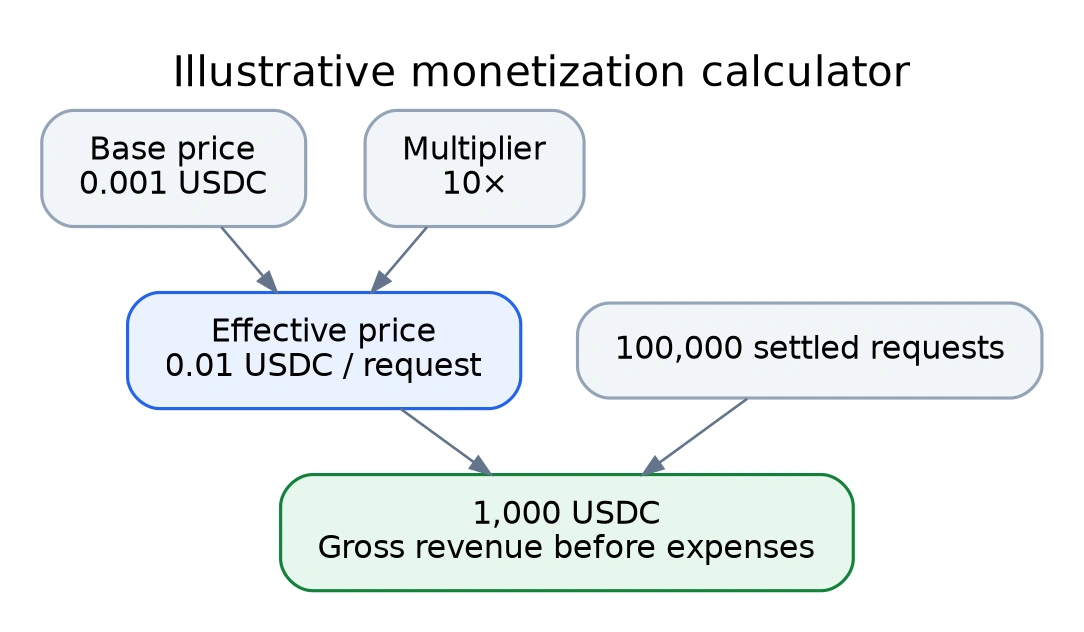
Illustrative gross revenue calculation. Assumes all paid requests settle successfully; excludes infrastructure expenses, payment fees, and operating costs.
For example, a business charging 0.001 USDC per request with a price multiplier of 10 would collect 0.01 USDC per successful paid request. At 100,000 successfully settled requests, gross revenue would equal 1,000 USDC before expenses.
Businesses should evaluate actual payment conversion rates, infrastructure expenses, and transaction overhead before establishing production pricing.
Which Businesses Can Monetize AI Agent Traffic?
AI traffic monetization is particularly relevant to organizations that own proprietary content, valuable datasets, premium APIs, or specialized digital services that AI agents can consume.
Business type | Monetizable digital resources |
|---|
Digital publishers | Premium articles, licensed content and historical archives |
SaaS providers | Premium API endpoints and on-demand application functions |
Data providers | Proprietary datasets, market intelligence and data feeds |
Research organizations | Research reports and specialized knowledge repositories |
E-commerce platforms | Product intelligence, pricing data and inventory APIs |
AI application providers | Agent-accessible tools, inference endpoints and AI services |
Rather than charging for every automated interaction, businesses can selectively monetize resources that provide distinct commercial value.
For example, a financial data provider could keep educational articles publicly accessible while introducing per-request pricing for real-time market intelligence APIs.
These examples represent potential business applications, not confirmed customer implementations.
When Should Businesses Allow, Block, Rate-Limit or Monetize AI Agents?
Businesses should choose AI traffic policies based on the agent's identity, access authorization, request frequency, resource sensitivity and commercial value.
At CodeConductor, we recommend treating AI traffic monetization as an application governance decision rather than applying payment requirements indiscriminately across an entire website.
AI Agent Traffic Governance Decision Framework
Traffic scenario | Recommended policy | Business objective |
|---|
Legitimate AI search crawler accessing public content | Allow | Maintain AI search discoverability |
Unknown bot requiring further investigation | Monitor or count | Establish traffic patterns |
Authorized crawler exceeding acceptable request volumes | Rate-limit | Protect infrastructure capacity |
Compatible AI agent requesting a premium API | Monetize | Recover costs or generate revenue |
AI training crawler requesting licensed content | Block or selectively monetize | Protect intellectual property |
Automated client attempting unauthorized access | Block | Enforce application security |
Verified agent requesting sensitive information without authorization | Block | Maintain access control |
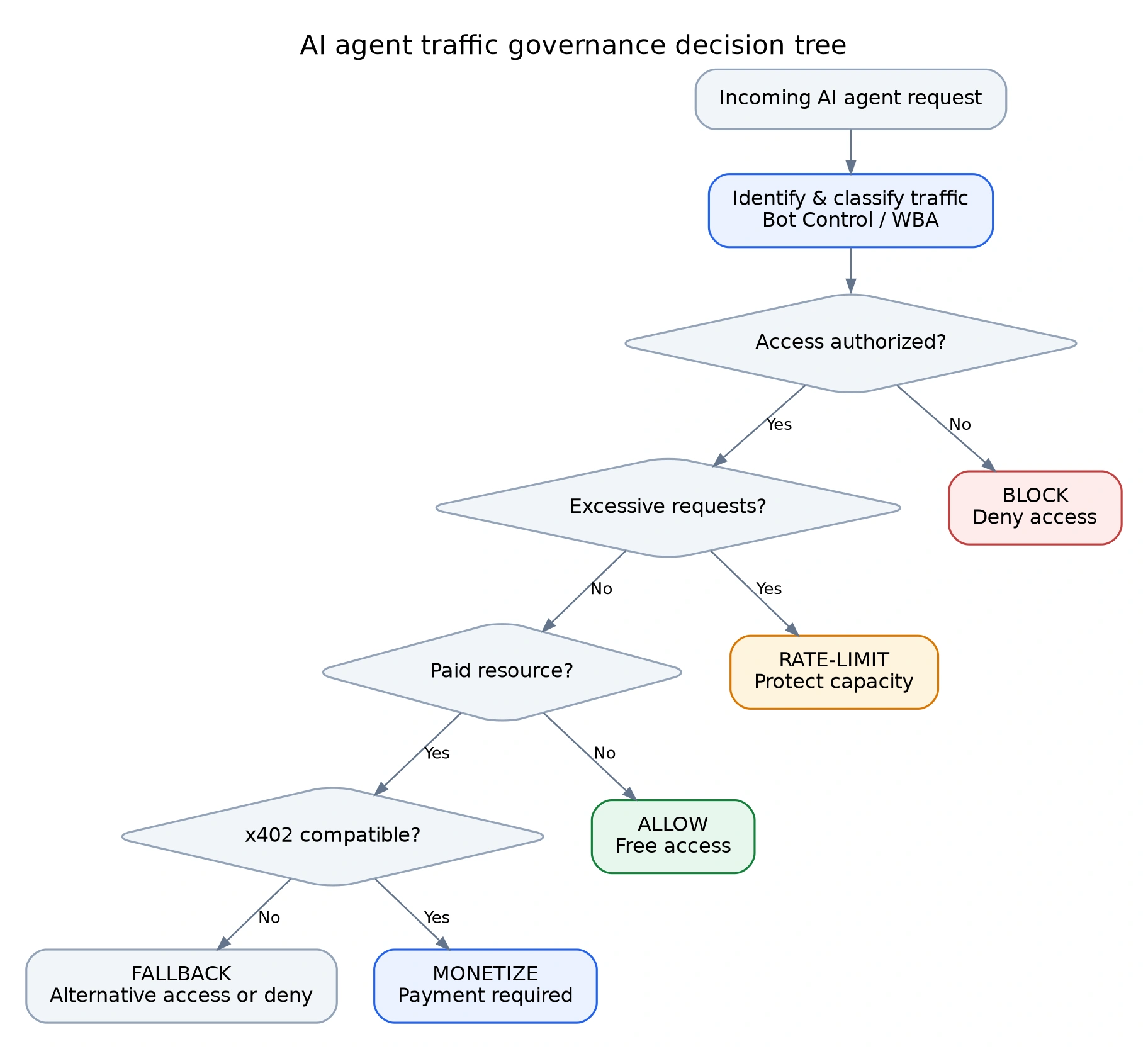
Figure 2. AI agent traffic governance decision framework. Illustrative, not an executable AWS WAF rule sequence. Unknown traffic may require monitoring; rule priorities and fallback behavior depend on application requirements.
The central principle is that verified identity establishes who is requesting a resource, authorization determines whether access is permitted, and monetization establishes the commercial conditions of permitted access.
Payment should not replace application security or authorization controls.
How to Monetize AI Traffic Without Losing AI Search Visibility?
Businesses can monetize AI traffic without unnecessarily restricting AI search visibility by separating publicly discoverable content from protected, commercially valuable resources.
Indiscriminate payment requirements may prevent AI discovery crawlers from retrieving content, particularly when those crawlers do not support x402.
1. Preserve Access for Legitimate Search Crawlers
Maintain appropriate access for search crawlers and AI discovery services responsible for content indexing and retrieval.
According to Google's guidance on AI features and website visibility, content must be indexed and eligible for search snippets to qualify as a supporting link in Google AI Overviews and AI Mode.
Blocking crawler access or placing payment challenges in front of publicly discoverable content can undermine this eligibility.
2. Separate Public and Monetized Resources
Configure payment policies around resource sensitivity and commercial value instead of monetizing every automated request.
Publicly discoverable resources | Potentially monetized resources |
|---|
Product landing pages | Premium API endpoints |
Public educational articles | Licensed research reports |
Service documentation | Proprietary datasets |
Product descriptions | Specialized data feeds |
Public knowledge resources | Agent-accessible paid services |
This approach helps businesses preserve brand discovery while establishing commercial controls around premium resources.
3. Define Content Licensing Terms
The x402 protocol facilitates payment for resource access, but payment alone does not establish how the retrieved content may be used.
AWS describes Really Simple Licensing (RSL) as an option for communicating machine-readable content usage terms to compatible AI agents.
Businesses can make licensing information discoverable through robots.txt directives, HTTP Link headers, HTML license references, or supported feed metadata.
These mechanisms communicate usage terms; they do not independently guarantee compliance.
Content licensing should form part of broader AI governance practices in software development.
4. Monitor Revenue and Payment Performance
AWS WAF revenue analytics provides visibility into payment settlements, monetization events, revenue sources, and monetized content paths.
Businesses should evaluate monetization performance alongside infrastructure and discovery metrics.
Performance metric | What it measures |
|---|
Successfully settled revenue | Actual gross monetization proceeds |
Payment completion rate | Ability to convert payment challenges into settlements |
Failed verification rate | Payment authorization and compatibility issues |
Revenue by resource path | Commercial value of individual resources |
Infrastructure cost per request | Economic viability of monetized access |
AI search citations | Potential changes in brand and content discoverability |
Payment processing latency | Impact of payment workflows on agent experience |
Some metrics, such as AI search citations and application infrastructure costs, require monitoring outside AWS WAF revenue analytics.
Revenue analytics helps businesses determine whether paid AI traffic access generates sustainable value rather than simply reducing automated request volumes.
5. Test Monetization Policies Before Production Deployment
AWS WAF supports test transactions through Base Sepolia and Solana Devnet for self-managed wallet configurations.
Before enabling production payments, businesses should validate:
AI bot classification accuracy.
Payment authorization and settlement.
Resource-specific pricing.
Human visitor access.
Compatibility with intended AI agents.
Payment failure and retry behavior.
Connected payment-provider accounts support production settlement only.
Businesses should also consider payment processing latency. AWS notes that verification and blockchain settlement can add several seconds to requests involving actual payment attempts, depending on network conditions.
What AI Traffic Monetization Means for Machine-to-Machine Commerce
AWS WAF and x402 introduce a programmable payment model through which compatible AI agents can purchase access to selected digital resources without traditional checkout interactions.
This model could support pay-per-request APIs, on-demand data retrieval, licensed digital content, and automated service consumption.
The upcoming AWS re: Invent 2026 NET334 session reflects growing interest in combining automated traffic identification, programmable access policies, and machine-to-machine payments.
For businesses, the opportunity is not to monetize every AI interaction. It is to establish an architecture that balances four priorities:
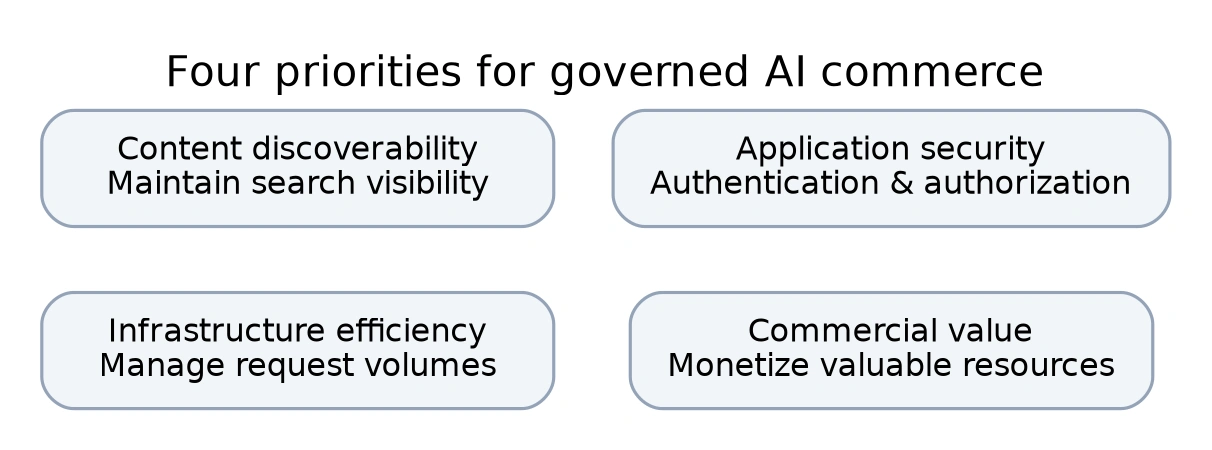
Four priorities for machine-to-machine commerce.
AWS WAF provides edge-level traffic and payment controls, while x402 facilitates automated resource payments. The underlying applications determine which capabilities and resources AI agents can securely consume.
Where Does CodeConductor Fit into the AI Agent Monetization Ecosystem?
AI agent monetization requires more than implementing a payment protocol. Businesses need applications that expose valuable digital resources through secure APIs, enforce access permissions, and support integrations with external infrastructure.
While AWS WAF manages incoming traffic and x402 facilitates automated payments, CodeConductor focuses on the underlying application development and governance layer.
AI Agent Commerce Reference Architecture
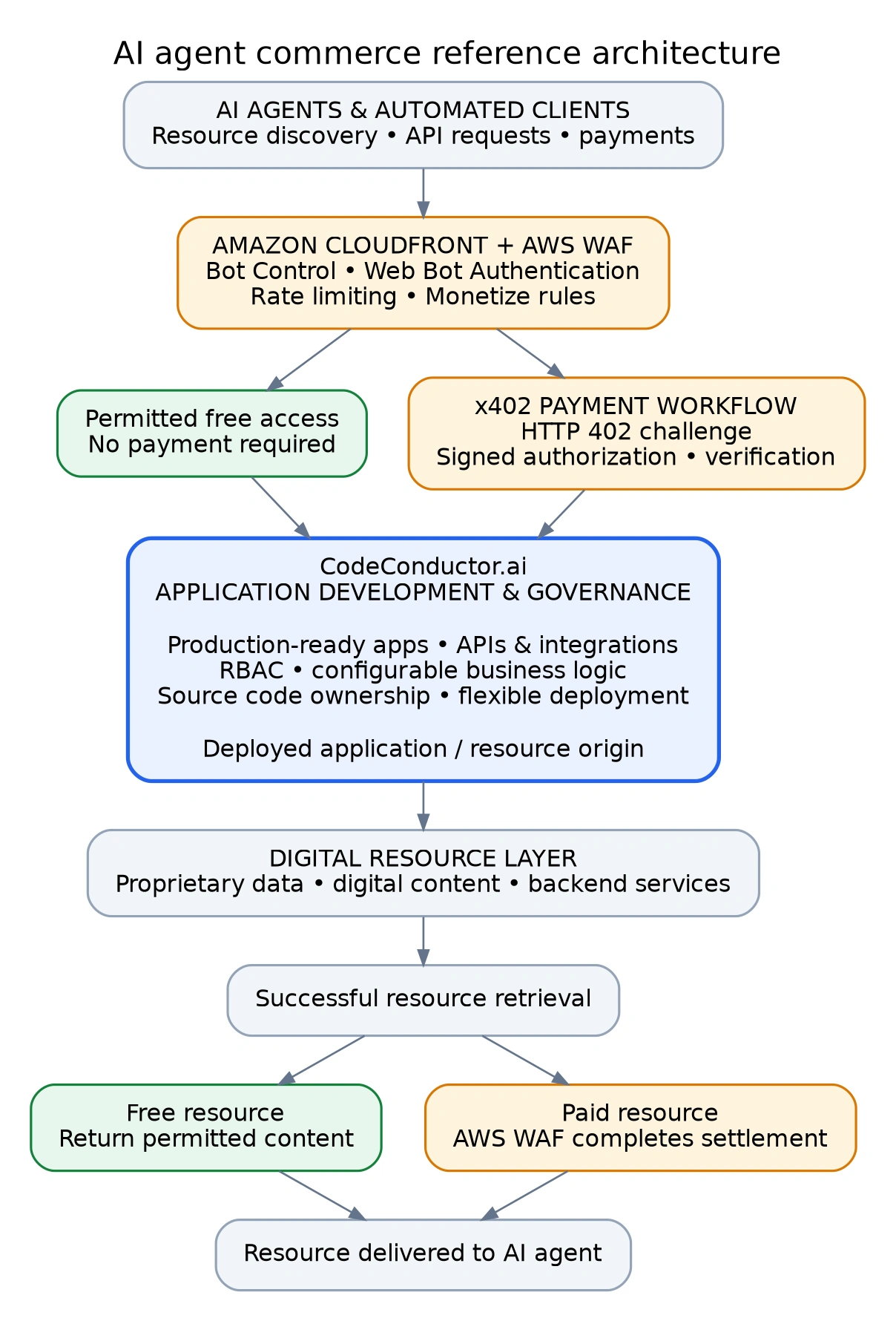
Figure 3. Illustrative AI agent commerce reference architecture. CodeConductor is the development platform, not a live payment intermediary. The deployed application serves as the origin where applicable. This is not an AWS-certified architecture or confirmed native integration. Failure paths and cached responses are omitted for simplicity.
Build Agent-Accessible Applications
CodeConductor enables engineering teams to build production-ready web applications, APIs and backend services that expose structured digital resources to authorized clients.
These resources could include proprietary datasets, specialized application functions, AI-powered services, and premium API endpoints.
Maintain Application-Level Governance
Role-based access controls, configurable business logic and API integrations help engineering teams establish resource boundaries and manage application-level permissions independently of edge-level traffic controls.
This separation ensures that payment requirements do not replace application-level security.
Retain Architectural and Deployment Control
CodeConductor provides source code ownership and flexible deployment options, allowing businesses to evaluate and integrate external infrastructure services according to their architectural requirements.
Engineering teams retain control over how their applications are deployed, extended, and connected to emerging payment infrastructure.
Prepare Applications for Emerging Payment Models
Beyond monetizing incoming website traffic, businesses can explore opportunities to develop and distribute applications specifically designed for agent-driven consumption.
The emerging model for building and monetizing x402-enabled applications on AWS Marketplace represents a complementary opportunity for software providers exploring paid APIs, application capabilities, and on-demand digital services.
Unlike AWS WAF's stablecoin-based edge monetization workflow, AWS Marketplace Agentic Commerce uses Amazon Bedrock AgentCore payments and AWS Billing to facilitate eligible agent-driven purchases in USD.
CodeConductor has announced plans to enable applications to use x402 payments, aligning its application development platform with emerging opportunities in agentic commerce. Specific implementation details, supported payment configurations, and availability timelines have not yet been confirmed in the published announcement.
Build Applications for the Agent-Driven Economy
AI agent monetization starts with applications designed for secure access, structured APIs, and architectural control.
With CodeConductor, build production-ready AI applications and backend services while maintaining governance, source code ownership, and deployment flexibility.
Ready to Build Without Code?
See how CodeConductor helps enterprises ship faster while staying compliant.
Get Started NowFrequently Asked Questions About AWS WAF and x402
Can website owners monetize AI crawlers without modifying application code?
Yes. AWS WAF supports edge-level monetization through CloudFront, allowing businesses to enforce payment requirements without necessarily adding payment-processing logic to existing applications.
Can AWS WAF monetize AI agents accessing cached content?
AWS WAF supports monetization of resources served through CloudFront. Payment enforcement depends on the applicable WAF rules and request characteristics, not solely on whether the resource is cached.
Can robots.txt enforce payment requirements for AI crawlers?
No. Robots.txt communicates crawler access preferences and can reference licensing terms. AWS WAF and x402 provide enforceable payment-based access controls for selected resources.
Does paying for content grant AI agents unrestricted usage rights?
No. x402 facilitates payment for resource access. Separate licensing terms, including machine-readable RSL policies, can define permitted content usage, redistribution or AI training rights.
Can every AI crawler complete x402 payments?
No. An AI crawler or agent must support the x402 payment workflow and an accepted payment network. Incompatible clients may be unable to access resources protected by Monetize rules.
What happens if an AI agent's x402 payment fails?
AWS WAF returns HTTP 402 and withholds protected content when payment verification or settlement fails. Origin responses with 4xx or 5xx status codes do not trigger settlement.
Can AWS WAF monetize traffic without blocking human visitors?
Yes. Businesses can configure Monetize rules using Bot Control labels and request-matching conditions to target automated traffic while maintaining normal access for human visitors.
How does CodeConductor support AI agent commerce?
CodeConductor helps engineering teams build governed applications, APIs, and backend services with source code ownership and flexible deployment, providing an application foundation for emerging AI agent commerce models.
Will CodeConductor enable applications to use x402 payments?
Yes. CodeConductor has announced planned x402 payment support to help businesses prepare for agent-driven transactions. Specific implementation details and availability timelines have not yet been confirmed.
Does CodeConductor replace AWS WAF for AI traffic management?
No. CodeConductor focuses on application development and governance, while AWS WAF provides infrastructure-level traffic inspection, bot management and payment policy enforcement.
Written by
Paul Dhaliwal
Founder & Chief Executive Officer
Paul Dhaliwal is a tech innovator and Founder of CodeConductor, an open-source no/low-code platform. With 10+ years of experience in AI and scalable development, Paul focuses on crafting intelligent solutions that drive real-world value. A firm believer in the mantra "Eat, Sleep, Code, Repeat," he balances his passion for software with a love for travel and family.