Top OpenClaw Alternatives for Secure, & Scalable AI Agents (2026) | CodeConductor
Ai Agents
Top OpenClaw Alternatives for Secure, Scalable AI Agents (2026)
Looking for OpenClaw alternatives in 2026? This guide breaks down the top platforms for building secure, scalable AI agents, highlighting key features like memory systems, integrations, and enterprise-grade capabilities to help teams evaluate and choose the right solution for production-ready AI...
Paul Dhaliwal
Founder & Chief Executive Officer · Updated Jun 4, 2026·9 min read
What You'll Learn
4 key concepts covered
1Understand OpenClaw’s core features, strengths, and common limitations at scale.
2Compare top OpenClaw alternatives by focus, memory, integrations, and team fit.
3Learn which platforms suit prototyping versus secure, production-ready deployments.
4See why Knolli emphasizes structured workflows, permissions, and enterprise-grade security.
AI agents are quickly becoming the backbone of modern automation—powering everything from internal workflows to customer-facing assistants. As teams push beyond simple task execution into multi-step reasoning, orchestration, and real-world deployment, many are reassessing the tools they rely on.
That’s where platforms like OpenClaw come into the picture. OpenClaw has helped teams experiment with AI agents and automated actions, but as requirements grow—persistent memory, production reliability, integrations, and scalability—many teams begin searching for stronger, more flexible alternatives.
If you’re evaluating your options, you’re not alone.
In this guide, we’ll walk through five of the best OpenClaw alternatives available today. You’ll get a clear view of what each platform does well, where it fits best, and how to choose the right AI agent solution based on your team’s goals—without unnecessary hype or forced comparisons.
What Is OpenClaw & Its Features
OpenClaw (Clawdbot or Moltbot) is an AI agent framework designed to help teams build and run autonomous agents that can perform tasks, call tools, and automate workflows. It’s commonly used to experiment with agent-based systems in which large language models coordinate actions across different tools and services.
At its core, OpenClaw focuses on agent execution and orchestration, enabling developers to define how agents think, act, and respond to inputs.
Key features of OpenClaw include:
AI agent execution Create agents that reason through tasks and take actions using predefined tools.
Tool and API calling Agents can interact with external services, APIs, and functions within workflows.
Workflow-style task handling Support for multi-step actions where agents move through a sequence of decisions.
Developer-centric setup Designed primarily for engineers who are comfortable configuring logic, prompts, and tools.
Experimentation-friendly Well-suited for testing ideas, proofs-of-concept, and early-stage agent behavior.
OpenClaw is best suited for teams that want to quickly prototype agent logic or explore how autonomous agents behave in controlled environments. However, as projects mature, teams often look beyond OpenClaw for capabilities such as persistent memory, production monitoring, team collaboration, and deployment flexibility.
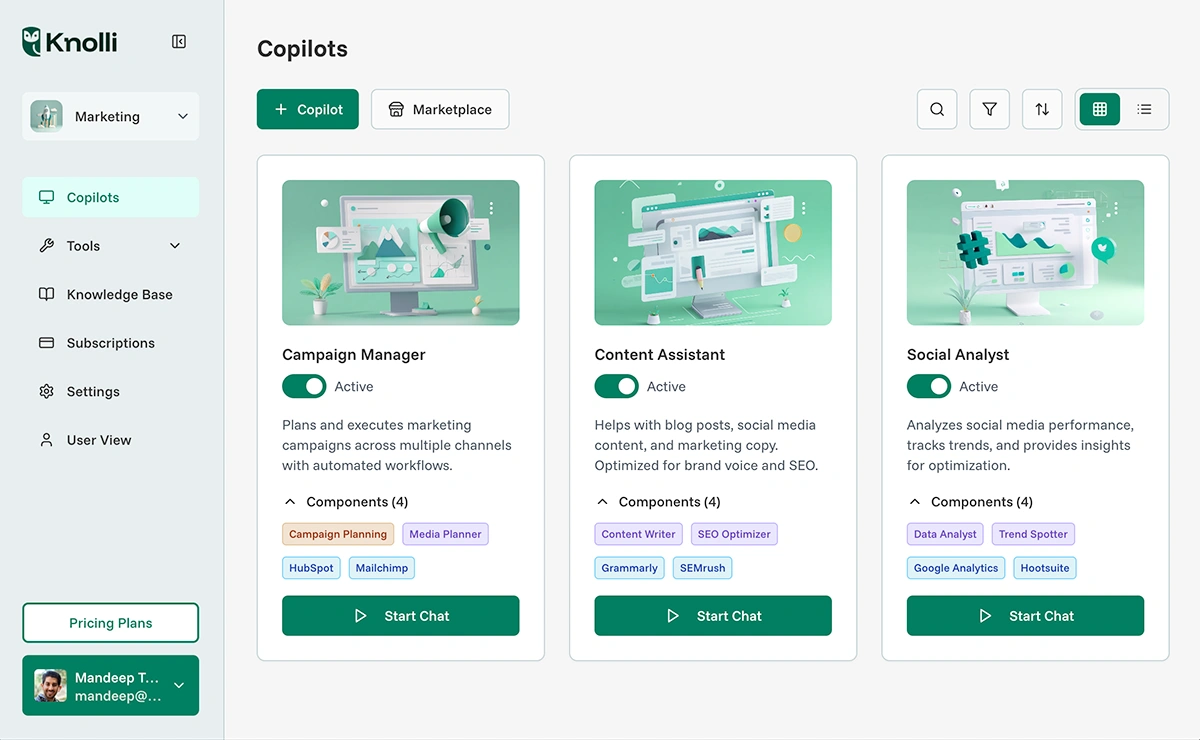
Knolli.ai is a secure, practical OpenClaw alternative built for businesses that need reliable AI automation without unnecessary risk. Unlike OpenClaw, which allows unrestricted local system access and exposes teams to credential and security issues, Knolli provides no-code AI copilot creation, structured workflows, and enterprise-grade security.
With clearly defined permissions and a fully managed infrastructure, Knolli enables teams to deploy AI solutions safely, making it a far more dependable OpenClaw alternative for real-world use.
What Knolli does best:
Builds structured AI-powered workflows instead of open-ended agents
Connects easily with SaaS tools and APIs
Reduces manual effort across operations and internal processes
Strengths:
Easy to reason about and maintain
Designed for repeatable, business-critical tasks
Lower risk compared to fully autonomous agent systems
Ideal use cases:
Internal automation (ops, support, data handling)
Task-based workflows that need consistency
Teams prioritizing reliability over agent autonomy
Who Knolli is not for:
Teams looking for deep multi-agent reasoning
Highly autonomous or self-directed AI agents
Heavy experimentation with emergent agent behavior
Claude Code is an AI-powered coding environment built around the Claude language model. Unlike traditional agent frameworks, Claude Code focuses on assisting developers directly inside the coding process, rather than orchestrating autonomous workflows.
It’s best thought of as a developer companion—helping with writing, understanding, refactoring, and reasoning about code—rather than a system that runs agents continuously in production.
Get insights in your inbox!!
Weekly tips on building smarter apps. Join 8,200+ founders and builders.
No spam. Unsubscribe anytime. We respect your privacy.
What Claude Code does best:
Assists with code generation, debugging, and refactoring
Handles complex reasoning across large codebases
Helps developers think through architecture and logic
Strengths:
Strong natural language understanding for technical problems
Excellent for iterative development and problem-solving
Feels natural for developers already working in code
Ideal use cases:
Writing and reviewing application code
Exploring solutions to complex engineering problems
Developer productivity and learning workflows
Who Claude Code is not for:
Teams looking to deploy autonomous AI agents
Workflow automation or task orchestration
Production systems that require persistent memory or stateful agents
Anything LLM is an open-source platform that enables users to interact with large language models in a flexible, centralized way. Rather than focusing on agents or automation, Anything LLM acts as a control center for working with LLMs, documents, and vector databases.
It’s especially popular with builders who want full visibility into prompts, embeddings, and model behavior without being locked into a hosted workflow tool.
What Anything LLM does best:
Provides a unified interface for prompting and managing LLMs
Supports document ingestion and retrieval via vector databases
Offers local or self-hosted setups for greater control
Strengths:
Open-source and highly configurable
Strong fit for experimentation and RAG-style workflows
Easy to swap models and data sources
Ideal use cases:
Knowledge assistants and document Q&A
Local or privacy-sensitive LLM deployments
Teams experimenting with retrieval-augmented generation
Who Anything LLM is not for:
End-to-end AI automation or orchestration
Multi-agent systems with complex logic
Teams needing production-ready workflows out of the box
Nanobot is a lightweight AI agent tool focused on simplicity and speed. It’s designed for builders who want to create small, focused agents without the overhead of complex orchestration frameworks or heavy infrastructure.
Nanobot keeps things intentionally minimal, making it easy to experiment with agent behavior, scripts, and task automation at a small scale.
What Nanobot does best:
Creates simple, task-focused AI agents
Enables quick experimentation with minimal setup
Works well for scripts, utilities, and micro-automations
SuperAGI is an open-source framework designed to create autonomous AI agents that plan, reason, and act with minimal human intervention. It’s one of the better-known platforms in the agent ecosystem and is often used to experiment with multi-agent systems.
SuperAGI is geared toward developers who want deep control over agent behavior and are comfortable managing infrastructure, prompts, and integrations themselves.
What SuperAGI does best:
Supports autonomous and multi-agent systems
Includes memory and planning capabilities
Allows agents to use tools and plugins to complete tasks
Strengths:
Open-source and highly extensible
Strong fit for research and experimentation
Active community and ecosystem
Ideal use cases:
AI research and agent experimentation
Complex autonomous task execution
Teams building custom agent frameworks
Who SuperAGI is not for:
Non-technical teams
Turnkey production deployments
Organizations needing managed reliability and compliance
How to Choose the Right OpenClaw Alternative?
With so many AI agents and automation tools available, choosing the right OpenClaw alternative comes down to what you’re actually building today and how far you expect it to scale.
Here are a few key questions to guide your decision:
1. Are you experimenting or building for production?
If you’re testing ideas or exploring agent behavior, lighter or open-source tools work well.
If you’re deploying AI systems that run continuously, reliability and monitoring become critical.
2. Do you need autonomy or structure?
Fully autonomous agents are powerful but harder to control.
Structured workflows are easier to maintain, debug, and scale.
3. How technical is your team?
Developer-first frameworks offer flexibility but require setup and maintenance.
Some platforms prioritize speed and simplicity over customization.
4. Will your AI need memory and context?
Session-only tools are fine for short interactions.
Long-running workflows often require persistent memory and state.
5. What integrations matter most?
Consider whether your AI needs access to APIs, databases, internal tools, or SaaS platforms.
Integration depth often determines how useful an agent is in real-world workflows.
The best OpenClaw alternative isn’t the one with the most features—it’s the one that aligns with your team’s skills, your use case, and your long-term roadmap.
The Future of AI Agents
AI agents are moving fast—from simple task executors to systems that can reason, plan, and operate across entire workflows. What started as experimental tooling is quickly becoming foundational infrastructure for modern software teams.
A few key trends are shaping where AI agents are headed:
From single actions to multi-step reasoning
Early agents focused on one-off tasks. The next generation is designed to handle multi-step workflows, make decisions mid-process, and adapt based on outcomes.
Persistent context and memory
Stateless interactions are giving way to agents that remember users, tasks, and prior decisions. Persistent memory is becoming essential for real-world applications like onboarding, support, and internal automation.
Better control and observability
As agents take on more responsibility, teams need visibility—logs, traces, and guardrails that make AI behavior understandable and predictable.
Production-first thinking
The future of AI agents isn’t just experimentation. It’s deployment—running agents reliably in production, integrating with real systems, and meeting security and compliance requirements.
Collaboration between humans and agents
Rather than replacing humans, AI agents are evolving into collaborators—handling repetitive work, surfacing insights, and supporting decision-making at scale.
As these trends continue, teams will increasingly look beyond basic agent frameworks and toward platforms that support long-running, integrated, and production-ready AI systems.
Ready to Build Without Code?
See how CodeConductor helps enterprises ship faster while staying compliant.
OpenClaw is used to build and run AI agents that can perform tasks, call tools, and automate workflows. It’s commonly used to experiment with agent-based systems and early-stage automation.
What is the best OpenClaw alternative?
There’s no single “best” alternative for everyone. Tools like Knolli, Claude Code, Anything LLM, Nanobot, and SuperAGI each serve different needs—from structured automation to agent experimentation and developer productivity. The right choice depends on your team’s goals and technical depth.
What is the most secure OpenClaw alternative?
Knolli is the most secure OpenClaw alternative because it focuses on structured workflows, controlled execution, and predictable automation with strong access controls.
What OpenClaw alternative has the best memory system?
SuperAGI has the best memory system among OpenClaw alternatives, offering built-in agent memory and context retention for long-running and multi-step agent tasks.
Should I use OpenClaw or an alternative?
Yes, you should use an alternative if OpenClaw does not meet your requirements for scalability, memory, security, or production readiness.
Key Takeaways
4 essential insights
Use OpenClaw for prototyping; switch when you need production reliability and monitoring.
Prioritize alternatives with persistent memory, secure permissions, and scalable deployment options.
Match platforms to team needs: workflows, coding help, agent scripts, or multi-agent systems.
Choose Knolli for secure, structured automations with managed infrastructure and SaaS integrations.
Paul Dhaliwal is a tech innovator and Founder of CodeConductor, an open-source no/low-code platform. With 10+ years of experience in AI and scalable development, Paul focuses on crafting intelligent solutions that drive real-world value. A firm believer in the mantra "Eat, Sleep, Code, Repeat," he balances his passion for software with a love for travel and family.
⚡
Build your app
No coding. No designers. Just describe what you want and watch AI build it.

![#1 Chatbase Alternative for Multi AI-Driven Workflows [2026]](/_next/image/?url=%2Fuploads%2Fchatbase-alternative-rmsb-800.webp&w=3840&q=75)